A Freak Accident — a reflective story about a life-threatening accident, faith, fast decisions, medical care, friendship, resilience and gratitude.
Brief introduction
When curiosity, bad luck and one split second became a story of miraculous survival
On January 15, 2025, a management offsite at a remote Texas ranch — a day meant for business alignment, honest conversations, team bonding and a bit of adventure — changed in a matter of seconds into a life-threatening accident. What followed was more than the impact itself: fast decisions, medical care, prayer, friendship, remarkable coincidences, what felt like miracles, and quiet moments of grace. Through words and photos, this story takes you from the ranch and the gate to the ambulance, the hospital, the recovery and the deeper reflection afterward — on faith, resilience, gratitude and what truly matters when life suddenly becomes fragile.
Reading settingsChoose the short summary or the full detailed story, then set language and photo safety.
Show graphic accident photos
English · Full read · Safe for Work
Graphic medical accident photos are currently visible.
Two-Minute Summary
Between Iron Bars and Guardian Angels
On January 15, 2025, during a leadership offsite at a remote ranch near San Antonio, a day of strategy, team bonding and adventure suddenly became a life-threatening moment. What began with business alignment, shared meals, honest conversations and time with colleagues ended at a metal gate, where a simple clearance check around an ATV and trailer turned into a freak accident.
While checking whether the ATV would fit under the gate, Ruben leaned forward through the front opening of the ATV to understand a loud metal-on-metal sound. In that split second, his head struck a second iron bar. The impact caused a severe head and ear injury, heavy bleeding, shock, and a terrifying realization: life can change instantly.
Fast decisions, care and friendship
What followed was a chain of urgent decisions and deeply human moments. Colleagues stayed close, called 911, prayed, kept Ruben warm, helped him out of the cold ATV, and waited instead of trying to solve everything themselves. That decision mattered. The ambulance arrived by an unexpected route, and staying where they were helped prevent further delay.
During the long ambulance ride and emergency treatment, Ruben remained conscious. Doctors later confirmed that the wound reached the skull, but the CT scan showed no skull or brain damage. After many stitches and staples, painful treatment, and the support of colleagues, family, and medical staff, the outcome was far better than it could have been.
Faith, “God winks” and gratitude
This short version cannot hold every detail, miracle, coincidence, and reflection in the full story, but it captures the heart of it: quick action, friendship, medical care, faith, resilience, and gratitude. Ruben looks back on the accident not only as something traumatic, but also as a moment surrounded by remarkable timing, prayer, protection, and meaning.
Between Iron Bars and Guardian Angels is a story about the fragile line between ordinary life and life-changing impact — and about what remains when fear, pain, faith, love, and gratitude meet in the same unforgettable day.
Samenvatting in twee minuten
Between Iron Bars and Guardian Angels
Op 15 januari 2025 veranderde tijdens een leadership offsite op een afgelegen ranch bij San Antonio een dag van strategie, teambuilding en avontuur plotseling in een levensbedreigend moment. Wat begon met business alignment, samen eten, eerlijke gesprekken en tijd met collega’s, eindigde bij een metalen hek, waar een simpele controle rond een ATV en trailer uitmondde in een bizar ongeluk.
Terwijl Ruben controleerde of de ATV onder het hek door kon, leunde hij naar voren door de opening aan de voorkant van de ATV om te zien waar een hard metaal-op-metaal geluid vandaan kwam. In die fractie van een seconde raakte zijn hoofd een tweede ijzeren balk. De klap veroorzaakte ernstig letsel aan zijn hoofd en oor, veel bloedverlies, shock en het besef dat een leven in één moment kan veranderen.
Snelle beslissingen, zorg en vriendschap
Daarna volgde een keten van snelle beslissingen en diep menselijke momenten. Collega’s bleven dichtbij, belden 911, baden, hielden Ruben warm, hielpen hem uit de koude ATV en wachtten in plaats van alles zelf te willen oplossen. Die keuze bleek belangrijk. De ambulance kwam via een onverwachte route aan, waardoor blijven waar ze waren verdere vertraging voorkwam.
Tijdens de lange rit met de ambulance en de behandeling op de spoedeisende hulp bleef Ruben bij bewustzijn. Artsen stelden later vast dat de wond tot aan de schedel liep, maar de CT-scan liet geen schade aan schedel of hersenen zien. Na veel hechtingen en nietjes, pijnlijke behandeling en steun van collega’s, familie en medisch personeel, bleek de afloop veel beter dan hij had kunnen zijn.
Geloof, “God winks” en dankbaarheid
Deze korte versie kan niet alle details, wonderen, toevalligheden en reflecties uit het volledige verhaal bevatten, maar raakt wel de kern: snelle actie, vriendschap, medische zorg, geloof, veerkracht en dankbaarheid. Ruben kijkt terug op het ongeluk als iets traumatisch, maar ook als een moment vol bijzondere timing, gebed, bescherming en betekenis.
Between Iron Bars and Guardian Angels is een verhaal over de dunne lijn tussen het gewone leven en een gebeurtenis die alles verandert — en over wat overblijft wanneer angst, pijn, geloof, liefde en dankbaarheid samenkomen op één onvergetelijke dag.
Between Iron Bars and
Guardian Angels (EN)
Processing the Unthinkable
During a leadership offsite in Texas USA, Ruben Spruijt experienced a
life-threatening accident. Despite the chaos and potential for
catastrophic outcomes, quick actions by his colleagues, skilled medical
care, and a series of remarkable ‘coincidences’ ensured his survival.
Ruben reflects on the accident, the role of faith, teamwork, and
resilience in his recovery, and his deep gratitude.
His main goal in writing this article is to reflect on and process
what he witnessed and better understand what happened on January 15th.
Others have encouraged him to do the same, and he believes that putting
his thoughts into words will help him in this process. He’s also writing
this because the series of miracles and coincidences surrounding the
event are worth sharing. Beyond his own sense of wonder, he believes
someone might find value in his story
--------------------------------
Strategic Alignment,
Bridges, Bonding, and VR
The week of January 15th, 2025, I was in San Antonio, Texas, USA,
with eight other senior leadership colleagues from Dizzion. The primary
goal of this trip was to discuss, plan, align, and optimize our
organization and discuss business strategy for 2025 and beyond. An
equally important part of the trip was getting to know each other better
and building stronger connections, as many of us hadn’t met in person
before. The pandemic, remote work, and the ~1.5 years since Dizzion and
Frame merged into one organization (as a spinoff from Nutanix) made
meeting face-to-face challenging. It was great to meet colleagues in
person and spend time together.
Before Wednesday the 15th, we had already completed a full day of
meetings where we tackled key topics such as customer growth, churn,
team dynamics, market opportunities, and our unique position in the End
User Computing industry. In preparation for the event, we had all
completed the 5-Voices survey. We reviewed and discussed the results
with a coach, gaining valuable insights into our team dynamics. That
evening, we had a fantastic time with about 20 colleagues who live in
San Antonio. We threw axes, enjoyed a beer, and played VR games. Mary,
Z, Denise, R2, and I teamed up to fight zombies. As many of you know,
I’m a huge Top Gun fan, so naturally, my call sign on the leaderboard
was ‘Maverick.’ With 287 zombie headshots, I proudly lived up to the
name.
A Day at Geronimo Creek
Ranch
On January 15th, I woke up early, partly due to jet lag and partly
because we had to leave the hotel early for the ~2-hour drive to the
ranch located northwest of San Antonio. We gathered in the hotel lobby,
and with two cars, we headed to Geronimo Creek Ranch. Five colleagues
rode in the first car, while three colleagues and I stepped in Rob's big
truck. Rob, the CEO of our company (Dizzion – Desktop as a Service), is
a remarkable pioneer and a man of faith. He lives in San Antonio with
his wife and kids. Rob and I had met a few times over the past 1.5
years, but this was my first time meeting Chris and Denise in
person.
Together with my colleagues Chris, Denise, and Rob, we had a relaxed
and insightful conversation about family, kids, the USA, the
Netherlands, travel, books we’ve read, and the lessons we’ve taken from
them. It was nice to chat about non-work topics as well. Halfway through
the trip, we stopped at ‘BBQ - Eat Miler’ for breakfast. Who doesn’t
love a brisket sandwich at 8:36 AM? I couldn’t find a healthier option,
so I happily used that as an excuse to order that brisket sandwich .
After breakfast, we did some grocery shopping at a massive Walmart. I
have been to Walmart before, but never one this big—it was huge! While
there, I picked up some outdoor boots since we were on a ranch, and
things were sure to get dusty. I didn’t want to ruin my brand-new Nike
CrossFit trainers or my relatively new ON running shoes, and as a Dutch
guy, 40$ for waterproof leather outdoor boots is a great deal.
The day before we arrived at Geronimo Creek Ranch, Rob had already
driven a trailer loaded with a buggy and an All-Terrain Vehicle (ATV) to
the property. A close friend of Rob’s owns this family ranch, a massive
property surrounded by a professional fence and gate. The property is
often used for "guys’/gals’ weekends," including enjoying the silence,
hanging out at the pool, BBQ, or firepit, shooting, and hunting zebras,
antelopes, and other “wildlife.” Haha, welcome to Texas, I thought.
Gate and fence of the ranch
Business, BBQ, and Buggy Ride
We arrived at the house around 10:00 AM. After unloading the
groceries and stocking the refrigerator, we took a brief walk around the
property. Rob then gave us a safety briefing. The key takeaway: there
are big spiders, scorpions, and venomous snakes around, so “don’t put
your hand into holes,” and “always check your surroundings, especially
near bushes”. Copy!
While some colleagues set up Starlink for internet and WiFi, I
explored the house, looking for a power extension cord for my laptop. I
eventually found a large cord in a room that also stored ammunition and
housed two large gun safes. Based on the ammunition I saw, I could
imagine the safes holding pistols, shotguns, and sniper rifles. After
plugging in my laptop, I checked Starlink speed and ran a Frame session.
As expected, our solution worked seamlessly, even in this remote
location with higher latency. Although I already knew it would, it was
still great to see and use it in action myself —especially since it was
my first time using Starlink.
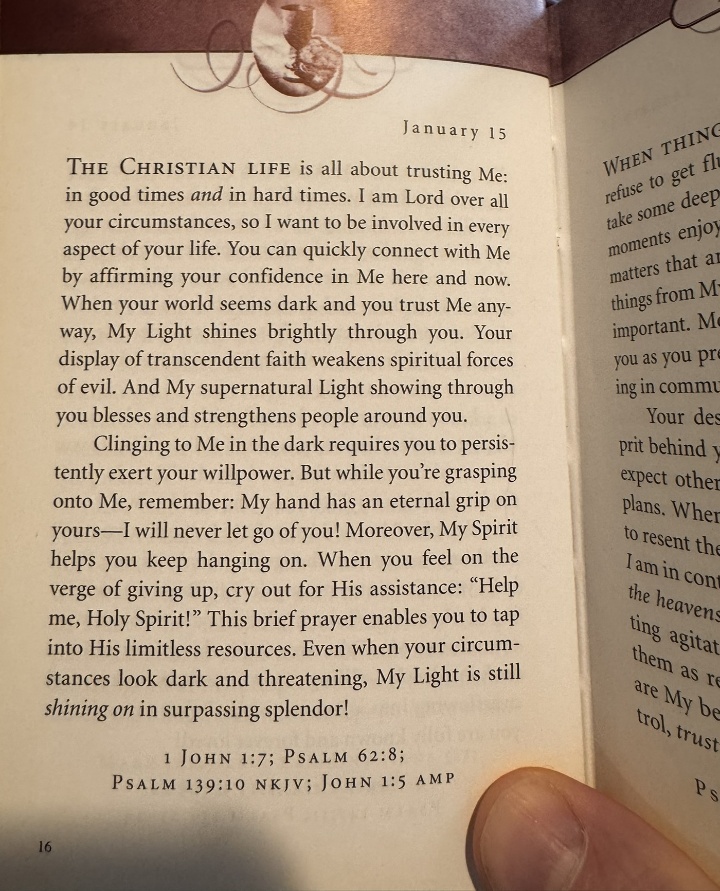
Daily diary – photo shot at 10:20 AM January 15th
Before we began the first
business block, we took a short break for refreshments. I walked around
the living space, noticing several personal touches. Rob’s friend, it
seemed, is a man of faith—there was a Bible verse posted on the wall, a
few Bibles on the table, travel books, and cookbooks with recipes,
judging by their covers. On top of two larger books, I spotted a smaller
daily diary. Curious, I opened it, and the first page I saw was dated
“January 15th.” It struck me as a funny coincidence, as that was the
exact date displayed on my Garmin watch. I snapped a photo of the diary
(time: 10:20 AM) to share with Jacoline later, planning to say, “Look…
how funny is this? I randomly opened a daily diary to today’s date!” At
the time, I didn’t pay much attention to the written text inside.
We started the first block with business topics and discussions. I’ll
spare you the business details since I am under NDA (), but after that
session, ChrisT, ChrisK, and I headed to a local BBQ restaurant to pick
up our order. As many of you know, I’m a big fan of BBQ, so walking into
this cozy, down-to-earth “mom and pop” spot, filled with regular folks
and the smell of smoked meat, was a treat. We drove back to the ranch,
about 20 minutes away, and enjoyed the food and conversations. Then, we
dove into the second block of business discussions. After wrapping up
that session, we took a short break. Some of the team explored the
property, checking out the surroundings, while Yangzhi and I had some
fun with RC cars and a DJI drone. The gear was amazing, and I couldn’t
help but think how great it is to have a professional, friendly, and
knowledgeable CEO colleague who’s also a bit of a “grown-up kid.” His
love for gadgets—like RC cars, drones, the Apple Vision Pro, buggies,
and All Terrain Vehicles (ATVs)— is great!.
ATV - All Terrain Vehicle
We continued with the third block of discussions and conversations.
Afterward, it was time to gear up with helmets and gloves as the ATV and
buggy were ready to roll. Yang-Zhi and I took the buggy, following Rob
and three other colleagues in the ATV as we navigated through bushes,
hills, and dusty trails. Z started as the driver while I rode as the
co-pilot. Halfway through, we switched seats, and I got behind the
wheel. The ride wasn’t particularly fast—around 25–30 mph—but it was
safe and a lot of fun. Everyone had a chance to either drive the buggy
or ride as a passenger in the four-person ATV.
Z and I in the buggy
We began the fourth and final block of business discussions, and
after a while, we decided to take a break and continued our
conversations while walking to a nearby pond. The fresh air really
helped clear our minds and opened the dialogue. By the time we returned,
it was around 5:00 PM. Chris T. and Chris K. had already started
building a bonfire. Judging by the smell of burning wood mixed with
gasoline, I could tell they had taken the ‘quick start’ approach. I
gathered some additional dry wood from the area since the larger logs
weren’t completely dry. About 20 minutes later, we had a nice fire
burning. We continued our (mostly) business discussions, but I also took
a moment to enjoy the fire, the view, and the great company. It’s such a
privilege to have no neighbors nearby—within a ~4-kilometer (~2-mile)
radius; it’s just open land. That means you can make a fire, play loud
music, shoot some guns, race an ATV, and not worry about anyone
complaining – not too bad!
We drank sodas and water, snacked on chips and fruit, and finished
the BBQ leftovers before tidying up the house. When we locked the door
and headed back to our hotel, it was around 7:30 PM.
Checking Clearance
The first car, carrying five colleagues, left ahead of us. Rob’s big
vehicle, with the connected trailer loaded with the buggy and ATV,
followed second. Inside were Chris, Denise, Rob, and me. As Rob drove
downhill to the gate, he opened the large metal doors and drove the
trailer forward a bit before stopping halfway through. He turned to us
and said, “Yesterday, when I dropped off the trailer with the buggy and
ATV, it was a close call with the gate—it barely fit the bar above me.
Chris and Ruben, can you check if the roof of the ATV clears the gate
bar?” we stepped out to look, and that’s when the ‘freak accident’
began.
Chris and I walked toward the trailer to check the clearance. Chris
climbed onto the trailer on the driver’s side, while I got on from the
passenger’s side. From my position, I could clearly see that the roof of
the ATV, including its six or seven headlights, would hit the large iron
bar of the gate. To get the ATV through, its height would need to be
lowered. Rob and/or Chris used a yellow lashing strap to press down the
ATV's suspension, effectively lowering it. Once the suspension was
lowered, Chris and I both double-checked the height. Using my phone’s
flashlight, I confirmed that the ATV's roof and headlights would clear
the first metal bar of the gate. Up until this point, I was standing
outside the ATV. I thought, why not sit inside the ATV? Adding
my weight would lower the suspension even more, providing additional
clearance.
Photo of the trailer – ATV and buggy, shot Friday the 17th
As Rob slowly drove the truck and trailer forward, a deafening
“iron-on-iron” screech pierced through the dark, cold evening. Rob
immediately stopped the car. In that split second, I leaned forward
headfirst through the ATV's front ‘window’ to see what had happened. My
head was above the roof as I looked left, trying to locate the impact
source at the back of the ATV’s roof.
I’m in the ATV, head out the front window, looking left to check the loud metal noise.
Headfirst, Struck by Iron
With my head above the ATV, still searching for the source of the
noise on the roof of the ATV, Rob continued driving a few more meters
(or feet). That’s when my head struck the second large iron bar. The
bar, of course, was solid and stationary, and I wasn’t aware of his bar,
but the trailer continued moving toward it. The right side of my head
hit the bar first. Instinctively, I turned my head and ducked to avoid
further impact, but in the process, my left ear struck the metal side of
the ATV’s roof.
There is a 2nd bar – not visible on photo – at the gate
Later, as I spoke with friends and family and reviewed photos from
the incident, the gravity of the situation became clear. If Rob had
driven even a little faster, if my head had been just a few centimeters
(or inches) higher above the ATV roof, or if my reflexes hadn’t been so
quick, the outcome could have been devastating. I could have been killed
instantly, my head crushed between the ATV roof and the iron bar. At the
very least, I might have been physically paralyzed and/or mentally
disabled.
These are the terrifying "what-ifs" that didn’t happen, and I feel
really blessed for that. Writing this now, just a week after the
accident, in good mental and good-ish physical health, feels like
nothing short of a miracle.
Later, when I analysed the situation, it became clear what had gone
wrong. Rob had warned us earlier that he wasn't sure the ATV would fit
since the gate was on a downhill slope. The problem was simple: the back
of the ATV’s roof was slightly higher than the front, which meant it had
hit the metal bar. Duh!
I was laying on the ground in the passenger seat, feeling a sharp
pain in my head. Instinctively, I reached up and felt something warm and
slushy on my scalp. When I looked at my right hand, it was covered in
blood—my arm, too. This is not good, I thought…
ATV passenger's seat – blood, jacket – photo taken on Friday 17th
The thought crossed my mind for a brief moment: This is it. This
is the end of my life on earth. Strangely, in that same instant, I
found myself singing a song - in my mind - a song to God about His love
for me and my love for Him. It was a short moment, but it was real.
Note: A few days later, when I was back home and when my
brother-in-law came over to check on me and talk through the details of
what had happened, I remembered it clearly. That memory hit me hard—it
was emotional, but I’m sure it happened. The realization that I was so
close to death, yet still singing a song to God, still stirs something
deep inside me. It’s overwhelming to think about. I can’t recall exactly
which song I sang then, but I know it’s one I’ve sung before and it’s
about God’s love for me and my trust in Him. When the timing is right, I
trust it will return to me.
While I was on the ground of the ATV, Chris turned to me and asked,
“Ruben, are you okay?” He asked because he had lightly bumped his head
against a pole. I responded calmly, “No, no, not good. Not good at
all.”
By then, Rob had jumped out of the truck and quickly used his phone’s
flashlight to assess the situation. He saw me sitting on the floor of
the ATV, blood covering the right side of my head, with a visible 5 by 5
cm (2 by 2 inch) hole. Despite the severity of the situation, I hadn’t
lost consciousness during the accident, which felt like a small relief
amidst the chaos. I remember Rob walking back to the truck momentarily,
muttering curses with intense energy, trying to process what had just
happened.
My body was shaking
uncontrollably from both trauma and the cold as I lay on the bare metal
floor of the ATV. I pulled up the hood of my hoodie to cover my head.
The hood also covered most of the bloody wound on my head, so my
colleagues—Denise, Chris, and Rob—had no idea how severe the injury
really was.
Later, in the hospital, I learned the cut was around 12 inches (25
cm) long and at widest point 2 inches (5cm). At the time, however, Chris
had only seen the blood pooling beneath the hood and estimated the wound
to be about 2 inches (5 cm). He shared that detail with the 911 operator
when calling for help.
A side note: on Sunday, I showered my head for the first time since
the accident and finally saw the wound in its entirety. It wasn’t a
straight line, as I’d assumed —it was shaped like a fishhook. The cut
ran from the top of my head down the side. The realization was shocking,
I had been scalped. When I turned my head and reflexively ducked to
avoid the metal bar, my ear struck the roof of the ATV, causing the
injury. Wow, Shit!
Meanwhile, Denise stepped out of the truck and stood behind me. She
grabbed an extra (ControlUp - LOL) hoodie from Rob, which he had in the
back of his car, and tried to warm me. Wrapping the hoodie around me,
she placed one arm on my forehead wound and the other over my heart,
saying something like, “Let my mother’s hands try to warm you.”
I started searching for my phone but couldn’t find it. I asked Chris
if he could look for it, and he found it on the roof of the ATV. He
handed it to me, and at 2:57 AM Netherlands time, I sent my wife,
Jacoline, two hearts via WhatsApp. I also quickly took a photo of myself
but didn’t look at it and, thankfully, had the clarity not to send the
photo to her. A single thought slipped through my mind: This might
be the last thing she hears or sees from me!
Help is Underway - Stay
Where You Are
Just a few minutes later, Chris called 911 while Rob worked on
finding the ranch's address, which was truly in the middle of nowhere. I
don’t know how long that took, but Denise stayed behind me during that
time, providing comfort.
At one point, I called out Rob’s name three times. He didn’t hear me
the first two times, but on the third, he did. He was standing near the
front of the ATV, and I asked him to pray for me and the situation. Rob
and I had previously shared conversations about business and personal
topics during our 1:1s, so I already knew we were spiritually aligned.
At that moment, his prayer felt deeply reassuring. I don’t know exactly
what he prayed, but I believe the prayer to God was a cry to God for
help, and it did help me and others at that time and maybe later as
well.
Note: Why do these miracles—or what some might call coincidences,
happen to me and not to others? Why am I still here, in good mental and
physical health? These are good questions; honestly, I don’t have the
answers. I know that miracles can and do happen—I’ve witnessed a few in
my life—and surviving this freak accident is undoubtedly one of them.
There’s more to this story, though. The other coincidences, miracles, or
what I like to call “God winks,” will come later. You’ll read about them
for sure.
After the prayer, Rob became calmer. A few days later, he shared with
me that he felt he was given two tasks after prayer: the first task was
to get me out of the ATV and get me into the warmth of the truck since
hypothermia was his concern. It was a cold evening—just 4°C (39°F)—and
the bare metal floor of the ATV made me start shivering almost
instantly. Getting me back into the truck might sound strange because
one of the key rules in dealing with accidents is not to move the
patient unless necessary. Moving someone without knowing the extent of
their head, neck, or back injuries could potentially cause even more
harm. However, Rob asked me if I could move. I carefully rolled my head,
and everything felt normal-ish. I climbed out of the ATV and with Rob
and Chris supporting me, we slowly made our way to the truck. I remember
the warm blood rolling down my back as I walked to the truck.
The second thing Rob felt after the prayer was a clear message:
“Don’t fix it yourself. stay where you are.” This went against
his instinct, as his usual approach is to jump into action with a “see
it, fix it” mindset—always eager to help and solve problems quickly. The
ambulance was estimated to take 30 minutes to arrive at the entrance
gate. Rob’s initial thought was to drive toward the ambulance to save
time. However, he later told me that he certainly would have missed the
ambulance if he had acted on that impulse. There were three possible
routes to the gate: one main “road,” another commonly used “road,” and a
third, a very small, rarely used road. And guess where the ambulance
came from? The third, least likely route. By staying at the gate and not
driving toward the ambulance, Rob ensured they didn’t miss each other
and avoided adding more time to the already critical situation.
I managed to climb into the back seat and lay down, still shivering
but slowly starting to warm up. Rob had called the ranch property
manager—a nephew of the owner who lived nearby—and he came over to help.
He brought some blankets, which, combined with the back seat heating and
those extra layers, helped me gradually regain warmth.
Later, Chris told me that the property manager had seen a cat cross
his path and, on his way to bring the blankets to the accident site, he
also ended up hitting a deer with his car, and that night was just after
a full moon. Imagine all this happening under the glow of a full
moon.
Rob was sitting in the front seat, holding my hand. Every now and
then, he gently squeezed it, asking, “Are you still there?” Each time, I
reassured him, “Yes—yes, I’m still here.” Three calls were made to 911;
one was to ensure they had the correct address. The final call was to
confirm how long it would take for the ambulance to arrive. I vaguely
remember hearing, “Three minutes, and they will be here.”
The Ride to Care
Around ~08:15PM I was loaded into the ambulance, and Chris joined me
– sitting in the front of the truck, carrying my backpack, phone, and
wallet. We slowly made our way off the bumpy roads, heading toward San
Antonio University Health—a 75-minute drive. I was able to communicate
with the paramedics, though it was slow because my head hurt while
trying to process and respond in my non-native English language.
I remember a young paramedic who seemed fresh out of school. He knew
what he was doing but was also obviously new to the job. It wasn’t quite
“learning on the job,” but it felt close. An older, more experienced
(and distinguished-looking) paramedic was also assisting him. At one
point, the young paramedic began setting up a drip—while the ambulance
was moving. I was alert enough to ask him twice if it was really a good
idea to do that while driving over bumpy roads. He confidently assured
me it was fine. I reluctantly thought, all right, let’s go. I’m
not a fan of needles, let alone while lying on a stretcher in a moving
vehicle bouncing along uneven roads. But at that moment, I just let it
go —after all, things could always be worse – and I was right.
They asked all kinds of questions needed for their dossier—my name,
insurance information, date of birth, and current date. I could answer
most of them, though I had to refer to some details from my wallet to
help them create a file on me.
It’s interesting how the sense of time disappears in moments like
this—the ride didn’t feel if the 75 minutes it actually was. About
halfway through, the older paramedic told the driver to speed up
wherever possible. At the same time, they ran out of the normal "big"
bandages to manage the bleeding and had to use “whatever was available.”
Despite their efforts, the bleeding still hadn’t stopped by the time we
arrived at the hospital. Another strange detail I recall is catching a
faint smell of cannabis in the ambulance at one point. It struck me as
odd, and I’m almost certain it was just my brain playing tricks on
me.
When we arrived at the hospital, I was asked similar questions—my
name, date of birth, and insurance details—to create my Electronic
Client Record (ECR) dossier. A few minutes later, I was brought into
Trauma Room/Emergency Room 12.
My Trauma Room Experience
Since this was a university hospital, I saw several people coming in
and out. While I’m no specialist, I think one of them was a “professor”
who seemed to be supervising; he mainly walked around asking questions.
A main doctor was working with me, along with two medical students
observing his actions. I also saw four different nurses, including a
main nurse, who connected me to the medical devices.
I learned that the cut went through three layers of tissue and
reached the skull. At that point, it wasn’t clear whether I had any
brain or skull damage, as the CT scan hadn’t been performed yet.
Thankfully, I had never lost consciousness, which was at least one
positive sign. Speaking of positives—though somewhat ironic—the
injection of anesthesia directly into the wound was
excruciating.
I’ve never experienced pain like that before. Even the stitching of
the wound was often very painful—likely because the anesthesia didn’t
fully cover all the areas or the nerves were cut – I don’t know, it was
f#ck sh#t - big time.
A couple of interesting observations: one of the medical students
fainted when she saw the wound when I entered the emergency room and had
to sit down to avoid losing consciousness completely. Meanwhile, other
‘students’ periodically peeked into the room—likely curious about ‘the
Dutch guy’ in the trauma room (or so I assumed) but also to see the
severity of the injury. The main nurse commented at the end of the
treatment that she hadn’t seen a head wound like this in the 10 years
she had been working at the hospital. Hmmm… great ... I thought to
myself.
The medical team started stitching the first layer of tissue and had
just begun working on the second layer when Chris came into the room to
check on me. He was completely shocked—he hadn’t expected the wound to
be so severe and so large. Earlier, all he had seen was a 2-inch (5 cm)
cut and my blood-covered head, partially hidden by the hood of my
hoodie, which made the injury seem much smaller. The reality, however,
was far more serious. He shared that his wife was praying for me and for
a speedy recovery.
I asked Chris to take a photo to see the wound for myself later. He
took one, but when he returned 30 seconds later, he realized the camera
timer had been set to 10 seconds. So, he took another one. He then
shared the photo with other colleagues who were waiting in the hospital
for updates and offering their support. They were all shocked after
seeing the photo of the injury.
Headshot photo taken during the second round of stitches
A CT scan was needed to determine whether my brain or skull had
sustained any damage. The scan was performed in just a few rooms from ER
12 and took about 10 minutes. It was my first time seeing a CT scanner
from the inside. After the scan, Chris returned, and we chatted for a
while. I couldn’t help but notice the hospital’s PC setup—Windows 11,
Imprivata, EPIC, and various scanners. Everything seemed fine, but we
joked that it would be even faster and more secure if they were using
Dizzion’s DaaS technology. Oh well, my brain was still working fine
- all good!
We waited together and eventually asked the nurse and doctor about
the next steps. The doctor and the nurse shared that if the CT scan
didn’t show any brain or skull damage, I would be discharged and sent
home. I also asked if, in that case, I could fly on Friday as planned.
The answer was simple: “Yes.”
The CT scan didn’t show any damage to my skull or brain, which was a
huge relief. With that cleared, the final step could begin. In the third
and last round of stitches and staples, the medical team worked to close
the wounds—60 stitches and staples for the head wound and another 10 for
my ear.
During this time, my colleagues Yangzhi (Z), Nemanja, and ChrisT came
by to see me. Z was especially emotional, felt deeply sorry and even
guilty about what had happened. We both cried as we hugged, and I
reassured him, saying, “No worries, everything will be fine. There’s no
need for guilt at all, for anyone!”.
While still doing the stitches and staples, I remember how painful
that was. The doctor asked, “Do you need more anesthesia injections?” I
remember asking how many stitches were left. “About 10,” he replied. I
thought about it and decided, “Let’s proceed with the stitches. The
injections are also super painful.” I counted down with every stitch and
staple. The doctor stopped at eight—great—but 10 minutes later,
he added two more stitches to stop the bleeding on my forehead.
F#ck.
The stitching was finally
done, and my head and body cleaning began. They used a cold-water mini
shower to spray and clean my head wound. The cold water went everywhere,
soaking my shirt, pants, and everything else. By the end of it, all my
clothing had to be thrown away. It had been cut off with scissors, was
full of blood, and was too dirty to salvage. So, I said goodbye to it
all—no collector items.
My ear also had quite a large
cut, and a plastic surgeon was waiting to stitch it up. By then, the
main wound on my head had been closed, the CT scan had positive results,
and I was somewhat cleaned up.
Around
8:00 AM in the Netherlands, I called my wife Jacoline via FaceTime. I
turned my camera off to avoid scaring her, but that plan didn’t work as
intended. Hearing my story alone was enough to leave her completely
shocked. My heart broke as I cried, telling her about the moment I
thought I might die on the spot, not seeing her anymore. It was one of
the hardest things to share.
We talked for about five minutes before the plastic surgeon arrived
to fix my ear. Another round of 10 painful injections and stitches
later, it was finally done. Sweet!
Meanwhile, my colleagues had gone to the hotel to collect all my
belongings. Rob insisted that I stay at his place so he could keep an
eye on me during my recovery. His wife had already prepared their
guestroom for me, and Rob had even gone out to buy some clothes for me
to use since my own was completely unusable. His kindness and support
meant so much to me—it was truly heartwarming.
We waited an hour and a half for my dossier/file to be completed.
After about an hour and 15 minutes, my colleagues checked on the delay
to figure out what was causing it. The simple answer? “We cannot find
him...” Sure, he’s Dutch and not a US citizen—that explains it.
I’m not entirely sure what went wrong—maybe it was my less-than-perfect
English , or maybe they thought I was local because someone else’s
English was even worse. Perhaps the systems weren’t connected, or it was
something else entirely. Either way, it didn’t really matter in the
end.
Since I wanted to fly back home on Friday—the flight had been booked
a while ago—and I was physically capable of traveling, we requested a
‘Fit to Fly’ document. This wasn’t just a note buried in the 10-page
medical file as written initially but we asked for a separate,
single-page document I could show to the airline crew if needed. With
the help of ChatGPT, we found a template outlining the required details,
and within five minutes, the paperwork was ready. We had everything: the
fit-to-fly letter, a list of prescribed medications to pick up, and no
lingering concerns—no credit card information shared, no kidney or
passport left behind. All good to go. Together with Nemanja and Chris,
we picked up the prescribed medications. Shortly after, Rob arrived to
pick me up and take me to his place. Before we left the hospital, I
asked Rob to pray and give thanks, and he did.
Moments of Care and
Gratitude
During the 15-minute drive to his home, I suddenly felt overheated
and thought I might vomit. About a minute later, Rob yelled, “RUBEN!” I
snapped awake, drenched in sweat. I had passed out. Rob immediately
said, “I’m heading back to the hospital,” but I insisted, “No, I’m fine.
Let me lower the window to cool down and get some fresh air.” After a
few moments, I felt better, and we continued driving to his house.
We arrived Thursday morning, and by ~5:30 AM, I finally crashed into
bed. I managed to sleep for about 1.5 hours, but it wasn’t restful. My
mind kept replaying the events like a movie, my head hurt, and I
couldn’t find a comfortable position to lay it—left, right, or back—all
sides were damaged and super sensitive. Thursday morning was mostly
about resting and writing a WhatsApp message to family and friends to
explain what had happened in more detail. This was an addition to the
thoughtful message Jacoline had already written and shared while I was
“asleep.” She did an amazing job keeping everyone informed.
All my senior leadership colleagues arrived at Rob’s place in the
afternoon, and we briefly talked and hugged each other. Later in the
evening, I had some chicken soup and bananas—eating was painful because
the accident had also impacted my jaws. Rob and I talked for about an
hour and a half, sharing our experiences, miracles, prayers, and the
event's impact on us. It was truly a meaningful and uplifting
conversation.
Rob made sure everything was ready for my trip. He organized special
assistance services at both the San Antonio and Atlanta airports and a
special ticket to help me navigate security and customs more easily. We
also connected with Kevin, who lives in Atlanta. He kindly offered to be
the backup plan in case the first flight didn’t go well or if, for any
reason, I needed to stay in Atlanta. His thoughtfulness was incredibly
reassuring.
I hadn’t taken any painkillers until Thursday night when I tried one
Advil to see how I would respond and to help me get a good night’s
sleep. Thankfully, it worked—I got 6.5 hours of rest, the most I’d had
during the whole trip so far. I woke up feeling refreshed and had a
great breakfast: scrambled eggs, a protein shake, vitamin water, and
bananas. Afterward, I took my second full-body shower, packed my
carry-on, and wrote a heartfelt letter to Rob to thank him for
everything.
Rob and his wife left briefly to bring their other car to the garage
and returned about 20 minutes later than planned, but we still had
plenty of time to get to the airport, which was just a 15-minute drive
from Rob’s place. Just move now
As we left the house, I noticed the trailer with the buggy and the
ATV. I thought to myself, "Let’s take a couple of photos. These
might come in handy later to explain what happened." And yes, they
ended up being very useful!
Two Steps Toward Home
At San Antonio Airport, I didn’t need the wheelchair service. It was
just a 3-minute walk to TSA, and I managed it alone – just slowly
moving. The Facial Recognition scanner didn’t work at the checkpoint –
duh. The TSA manager manually checked the passport and approved my entry
with a smile, and we both chuckled at the minor hiccup. There were no
security issues with my medicine, ice packs, or any of the extra items I
don’t normally travel with—everything went smoothly. While waiting at
the gate for my flight to Atlanta, Chris reappeared. What an amazing and
thoughtful colleague! He told me his wife had praised God and prayed for
my safe journey back to the Netherlands. We talked briefly before saying
goodbye.
When boarding began, I could enter the plane first and find my
seat—27H, a window seat. It wasn’t ideal because I needed to use the
bathroom frequently. The doctor had advised me to drink plenty of water
to aid my recovery, and I followed that advice—but it also meant lots of
trips to the bathroom. I would have preferred an aisle seat, and
luckily, I could swap with a guy who had the aisle seat. All set and
good to go!
Although the doctor had reassured me that I was "Fit to Fly," and I
had the official paperwork to prove it, I still felt a bit of tension as
I boarded the plane. I wasn’t sure how my head and wound would react to
the cabin pressure, noise, and overall environment.
First flight from San Antonio to Atlanta
That tension quickly faded
when the second or third person to board—who ended up sitting in the
middle seat next to me—asked, “What happened?” I replied, “Accident...”
to which he responded, “Yes, I can tell.” I then added, “Can you handle
some hospital photos?” He smiled and said, “Sure. I’m a paramedic and
active duty in the US military—I’ve seen some stuff...” I showed him a
few photos, and we ended up having a great conversation. We talked about
Arizona, Phoenix, and Sedona, and he even typed some tips on things to
do in Sedona. Long story short, this guy immediately felt like my
physical guardian angel during the flight. The coincidence—or as I’d
call it, a “God wink”—didn’t escape me. It felt like God was saying,
“I took care of you during the accident. You’ve already seen
miracles, and here’s someone to also look after you in case
needed.” I couldn’t help but smile at the humor and the sense of
reassurance in that moment.
The flight was about two hours, nothing particularly eventful, except
for a 20-minute delay, which shortened my layover in Atlanta from 55
minutes to around 35. It was still doable, but given my slower pace, it
wasn’t ideal. That’s where the wheelchair service came in handy. Rob and
my friend Kevin had made a great point earlier, telling Rob, “Pro
tip: Whatever happens, make sure Ruben gets into a wheelchair in
Atlanta— planes don’t leave until all wheelchair passengers are
accounted for.” He was right, the service worked perfectly, and I
made it to my gate on time.
Fit to fly!
The Dutch KLM crew of flight KL624 passed by while I waited at the
gate. We exchanged a quick “Hoi,” and I briefly chatted with the
captain. When I told them about my accident—head between an iron bar
and an ATV just 36 hours ago—they were wide-eyed and said, “Wait,
are you sure you’re okay to fly?” I reassured the captain with a smile,
“Yes, I’m fit to fly,” and he joined the rest of the crew.
I then approached the gate desk to ask a couple of questions. One was
about the availability of a Business Class seat. I had checked the night
before and earlier that morning, but none were available then. To my
surprise, the friendly gate agent told me, “Yes, there is one seat
left.” I joked, “What are the chances…. What are the chances the KLM
crew would swap my Economy seat for that Business Class seat?”. The
agent chuckled, shook his head, and said, “Well, four others on the
waitlist are willing to buy it for $975, so I don’t think it’ll still be
available when you board.” I smiled and replied, “Well, you’re either an
excellent salesman or completely right.” I made life a little easier for
myself and purchased the seat. A lie-flat bed, pillow, and blankets
sounded like a good investment for a 9-hour flight. A few minutes later,
the captain had asked the desk agent for proof that I was ‘fit to fly.’
I handed over the document provided by the hospital nurse, and
everything was checked out. Shortly after, I boarded the plane and was
shown to my Business Class seat by the KLM crew. Later, during the
flight, we had several conversations. The crew even took some photos of
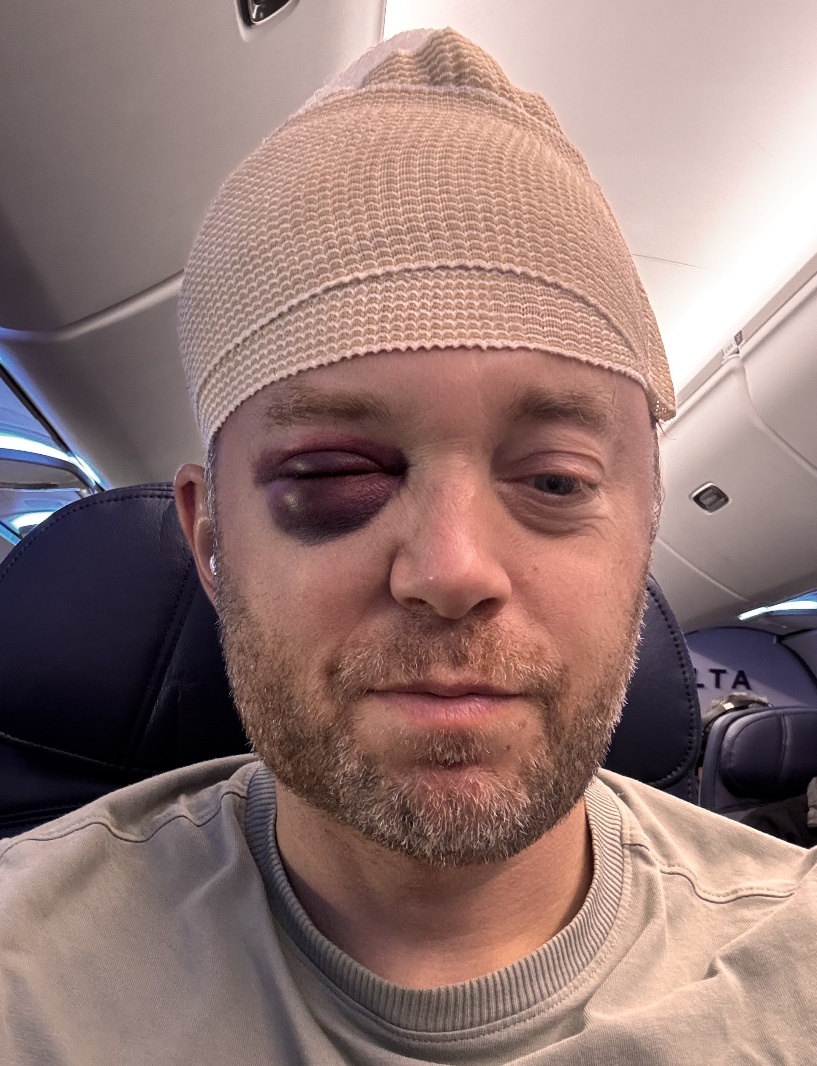
me: one with my current face, one of my business headshots, and another
showing the hospital photo of the wound. One of them remarked, “Wow, you
definitely had a few guardian angels.”
It's interesting—I usually manage to ‘sleep’ 4-5 hours in an economy
seat on flights like this. But this time, despite having the comfort of
a nice bed, pillow, and blanket, I only slept for 1.5 hours. My mind was
racing, and I found myself listening to music, praying, asking God
questions, and just being open to hearing what He had to say. And,
surprisingly, I wasn’t tired at all.
Pickup. Hugs. Home!
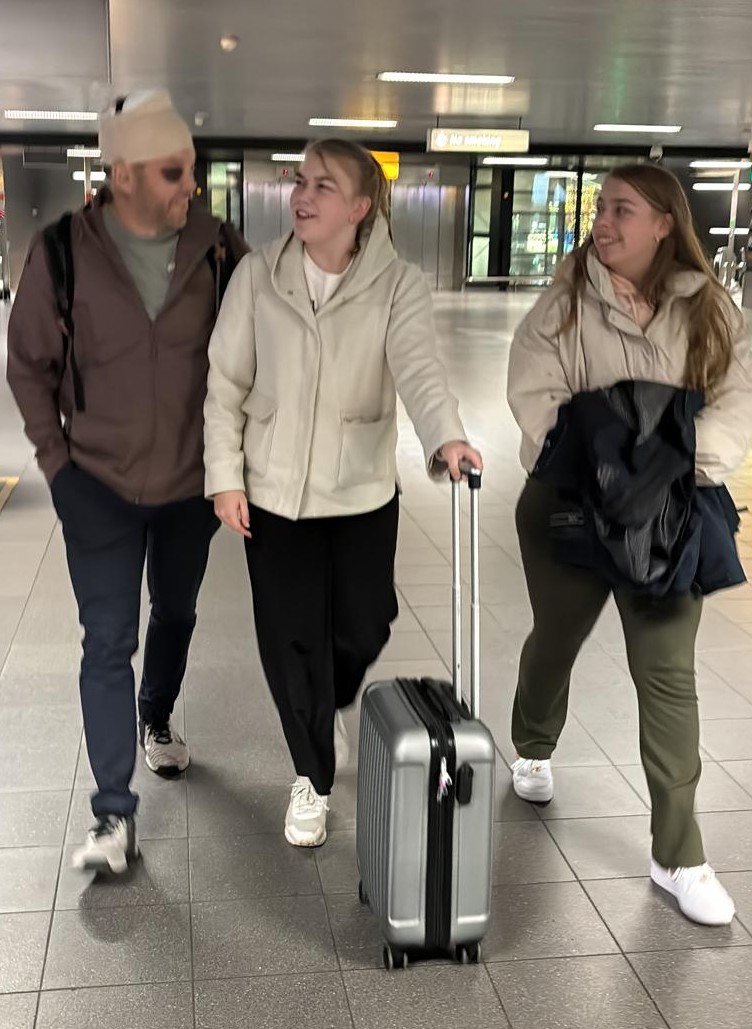
Happy faces when walking together to the car
I arrived at Schiphol Airport
on Saturday morning around 6:00 AM, it was cold and foggy, no
cancelations or delays of my flight. Jacoline, Rosalie, and Mirthe were
waiting for me. We hugged, hugged, and hugged—it was so incredible to be
back home and able to hug my family again.
On the drive home, we talked about what had happened. Once we
arrived, I went straight to bed for a much-needed 4–5-hour sleep. Later,
we talked more about the accident, using the photos of the trailer and
ATVs I had taken at the last minute at Rob’s place to explain better
what had happened.
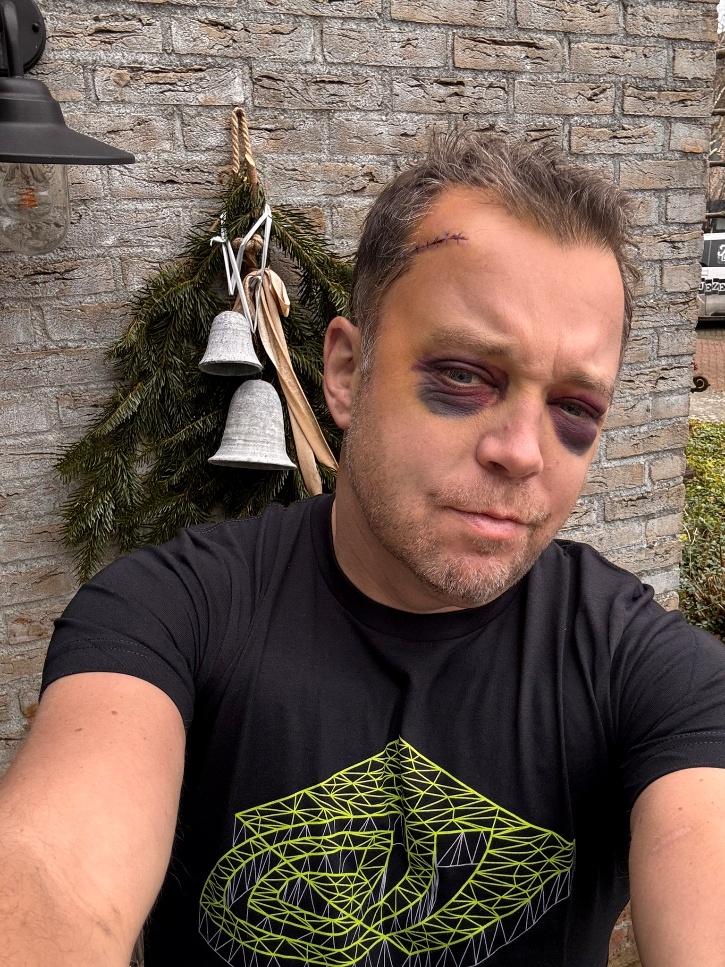
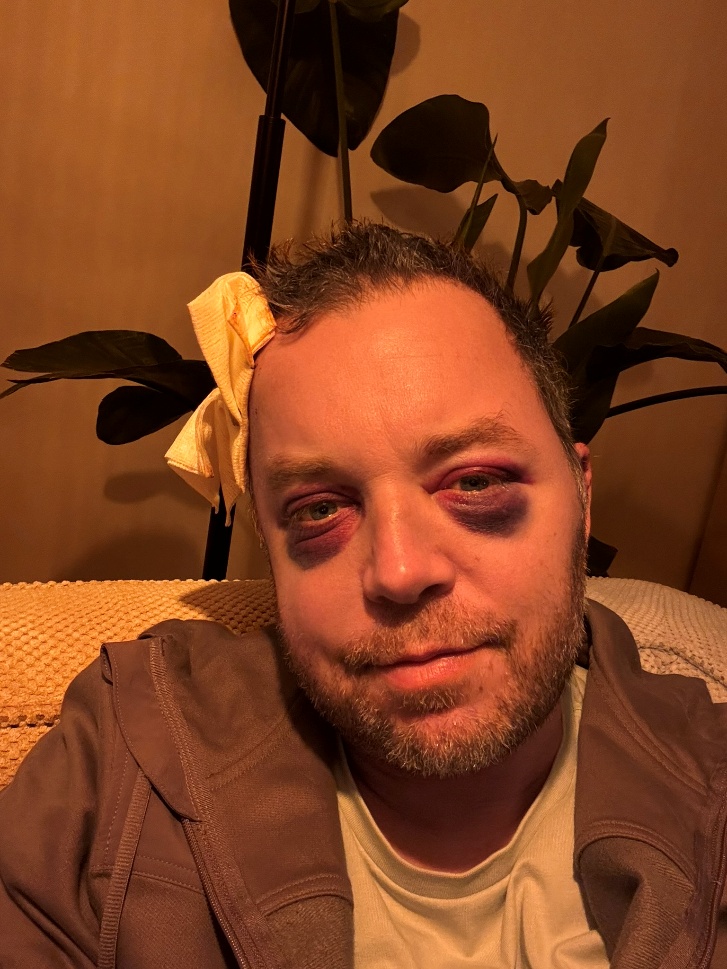
Kung-Fu Panda was the theme on Saturday and Sunday
Throughout the day, friends
and family arrived one by one. I spent time talking with them,
explaining the events, and showing photos to tell the story.
There were a few special “aha” moments during these conversations,
many of which I’ve already included in this story. However, there’s one
that I’ve saved until now—well, almost to the end.
The Diary’s Message on January 15th
On Saturday afternoon, I was scrolling through the photos on my phone
to show something to friends who were at our house, checking in on how I
was doing. While scrolling, I stumbled across a photo I had taken of the
daily diary at the Ranch on the morning of January 15th, the photo I had
shared in the document already! Of all the travel and food books I could
have opened, I had opened that one. Of all the 365 pages, I
opened it to January 15th, the exact date, and the accident date in the
evening. And now, reading what is on that page again, it is beautiful –
crazy! I know these words were written weeks, months, or maybe years ago
by someone who didn’t know about me and my experience on January 15th,
2025. Nevertheless, sometimes a page full of meaning can mean something
to someone else – like me!
Daily diary
January 15th
A page opened in the morning, read differently after the accident.
The Christian life is all about trusting me: in good times and in hard times. I am Lord over all your circumstances, so I want to be involved in every aspect of your life.
You can quickly connect with Me by Affirming your confidence in Me here and now.
When your world seems dark, and you trust me anyway, My light shines brightly through you.
Your display of transcendent faith weakens spiritual forces of evil and My supernatural Light showing through you blessed and strengthens people around you.
Clinging to Me in the dark requires you to persistently exert your willpower, but while you’re grasping onto Me, remember: My hand has an eternal grip on yours – I will never let go of you!
Moreover, My spirit helps you keep hanging on. When you feel on the verge of giving up, cry out for His assistance: “Help me, Holy Spirit” This brief prayer enables you to tap into His limitless resources.
Even when your circumstances look dark and threatening, My light is still shining on it, surpassing splendor!
John 1:7 – Psalm 62:8 – Psalm 139:10 (NKJV) – John 1:5 (AMP)Song reflection
Scars — a song that found me afterward
On Saturday, January 25th, I found the song Scars by I Am They. The lyrics touched me deeply after everything that happened — ❤😘🙏☀. It is worth a listen, and maybe worth reading slowly too.
If you have questions, notes, remarks or feedback — or if you would like to invite me for a motivational talk, keynote, interview or personal conversation — please visit the Bio & Contact page or email me directly at ruben@rspruijt.com.
Between Iron Bars
and Guardian Angels (SFW) (EN)
Processing the Unthinkable
During a leadership offsite in Texas USA, Ruben Spruijt experienced a
life-threatening accident. Despite the chaos and potential for
catastrophic outcomes, quick actions by his colleagues, skilled medical
care, and a series of remarkable ‘coincidences’ ensured his survival.
Ruben reflects on the accident, the role of faith, teamwork, and
resilience in his recovery, and his deep gratitude.
His main goal in writing this article is to reflect on and process
what he witnessed and better understand what happened on January 15th.
Others have encouraged him to do the same, and he believes that putting
his thoughts into words will help him in this process. He’s also writing
this because the series of miracles and coincidences surrounding the
event are worth sharing. Beyond his own sense of wonder, he believes
someone might find value in his story
--------------------------------
Strategic
Alignment, Bridges, Bonding, and VR
The week of January 15th, 2025, I was in San Antonio, Texas, USA,
with eight other senior leadership colleagues from Dizzion. The primary
goal of this trip was to discuss, plan, align, and optimize our
organization and discuss business strategy for 2025 and beyond. An
equally important part of the trip was getting to know each other better
and building stronger connections, as many of us hadn’t met in person
before. The pandemic, remote work, and the ~1.5 years since Dizzion and
Frame merged into one organization (as a spinoff from Nutanix) made
meeting face-to-face challenging. It was great to meet colleagues in
person and spend time together.
Before Wednesday the 15th, we had already completed a full day of
meetings where we tackled key topics such as customer growth, churn,
team dynamics, market opportunities, and our unique position in the End
User Computing industry. In preparation for the event, we had all
completed the 5-Voices survey. We reviewed and discussed the results
with a coach, gaining valuable insights into our team dynamics. That
evening, we had a fantastic time with about 20 colleagues who live in
San Antonio. We threw axes, enjoyed a beer, and played VR games. Mary,
Z, Denise, R2, and I teamed up to fight zombies. As many of you know,
I’m a huge Top Gun fan, so naturally, my call sign on the leaderboard
was ‘Maverick.’ With 287 zombie headshots, I proudly lived up to the
name.
A Day at Geronimo Creek
Ranch
On January 15th, I woke up early, partly due to jet lag and partly
because we had to leave the hotel early for the ~2-hour drive to the
ranch located northwest of San Antonio. We gathered in the hotel lobby,
and with two cars, we headed to Geronimo Creek Ranch. Five colleagues
rode in the first car, while three colleagues and I stepped in Rob's big
truck. Rob, the CEO of our company (Dizzion – Desktop as a Service), is
a remarkable pioneer and a man of faith. He lives in San Antonio with
his wife and kids. Rob and I had met a few times over the past 1.5
years, but this was my first time meeting Chris and Denise in
person.
Together with my colleagues Chris, Denise, and Rob, we had a relaxed
and insightful conversation about family, kids, the USA, the
Netherlands, travel, books we’ve read, and the lessons we’ve taken from
them. It was nice to chat about non-work topics as well. Halfway through
the trip, we stopped at ‘BBQ - Eat Miler’ for breakfast. Who doesn’t
love a brisket sandwich at 8:36 AM? I couldn’t find a healthier option,
so I happily used that as an excuse to order that brisket sandwich .
After breakfast, we did some grocery shopping at a massive Walmart. I
have been to Walmart before, but never one this big—it was huge! While
there, I picked up some outdoor boots since we were on a ranch, and
things were sure to get dusty. I didn’t want to ruin my brand-new Nike
CrossFit trainers or my relatively new ON running shoes, and as a Dutch
guy, 40$ for waterproof leather outdoor boots is a great deal.
The day before we arrived at Geronimo Creek Ranch, Rob had already
driven a trailer loaded with a buggy and an All-Terrain Vehicle (ATV) to
the property. A close friend of Rob’s owns this family ranch, a massive
property surrounded by a professional fence and gate. The property is
often used for "guys’/gals’ weekends," including enjoying the silence,
hanging out at the pool, BBQ, or firepit, shooting, and hunting zebras,
antelopes, and other “wildlife.” Haha, welcome to Texas, I thought.
Gate and fence of the ranch
Business, BBQ, and Buggy
Ride
We arrived at the house around 10:00 AM. After unloading the
groceries and stocking the refrigerator, we took a brief walk around the
property. Rob then gave us a safety briefing. The key takeaway: there
are big spiders, scorpions, and venomous snakes around, so “don’t put
your hand into holes,” and “always check your surroundings, especially
near bushes”. Copy!
While some colleagues set up Starlink for internet and WiFi, I
explored the house, looking for a power extension cord for my laptop. I
eventually found a large cord in a room that also stored ammunition and
housed two large gun safes. Based on the ammunition I saw, I could
imagine the safes holding pistols, shotguns, and sniper rifles. After
plugging in my laptop, I checked Starlink speed and ran a Frame session.
As expected, our solution worked seamlessly, even in this remote
location with higher latency. Although I already knew it would, it was
still great to see and use it in action myself —especially since it was
my first time using Starlink.
Daily diary – photo shot at 10:20 AM January 15th
Before we began the first
business block, we took a short break for refreshments. I walked around
the living space, noticing several personal touches. Rob’s friend, it
seemed, is a man of faith—there was a Bible verse posted on the wall, a
few Bibles on the table, travel books, and cookbooks with recipes,
judging by their covers. On top of two larger books, I spotted a smaller
daily diary. Curious, I opened it, and the first page I saw was dated
“January 15th.” It struck me as a funny coincidence, as that was the
exact date displayed on my Garmin watch. I snapped a photo of the diary
(time: 10:20 AM) to share with Jacoline later, planning to say, “Look…
how funny is this? I randomly opened a daily diary to today’s date!” At
the time, I didn’t pay much attention to the written text inside.
We started the first block with business topics and discussions. I’ll
spare you the business details since I am under NDA (), but after that
session, ChrisT, ChrisK, and I headed to a local BBQ restaurant to pick
up our order. As many of you know, I’m a big fan of BBQ, so walking into
this cozy, down-to-earth “mom and pop” spot, filled with regular folks
and the smell of smoked meat, was a treat. We drove back to the ranch,
about 20 minutes away, and enjoyed the food and conversations. Then, we
dove into the second block of business discussions. After wrapping up
that session, we took a short break. Some of the team explored the
property, checking out the surroundings, while Yangzhi and I had some
fun with RC cars and a DJI drone. The gear was amazing, and I couldn’t
help but think how great it is to have a professional, friendly, and
knowledgeable CEO colleague who’s also a bit of a “grown-up kid.” His
love for gadgets—like RC cars, drones, the Apple Vision Pro, buggies,
and All Terrain Vehicles (ATVs)— is great!.
ATV - All Terrain Vehicle
We continued with the third block of discussions and conversations.
Afterward, it was time to gear up with helmets and gloves as the ATV and
buggy were ready to roll. Yang-Zhi and I took the buggy, following Rob
and three other colleagues in the ATV as we navigated through bushes,
hills, and dusty trails. Z started as the driver while I rode as the
co-pilot. Halfway through, we switched seats, and I got behind the
wheel. The ride wasn’t particularly fast—around 25–30 mph—but it was
safe and a lot of fun. Everyone had a chance to either drive the buggy
or ride as a passenger in the four-person ATV.
Z and I in the buggy
We began the fourth and final block of business discussions, and
after a while, we decided to take a break and continued our
conversations while walking to a nearby pond. The fresh air really
helped clear our minds and opened the dialogue. By the time we returned,
it was around 5:00 PM. Chris T. and Chris K. had already started
building a bonfire. Judging by the smell of burning wood mixed with
gasoline, I could tell they had taken the ‘quick start’ approach. I
gathered some additional dry wood from the area since the larger logs
weren’t completely dry. About 20 minutes later, we had a nice fire
burning. We continued our (mostly) business discussions, but I also took
a moment to enjoy the fire, the view, and the great company. It’s such a
privilege to have no neighbors nearby—within a ~4-kilometer (~2-mile)
radius; it’s just open land. That means you can make a fire, play loud
music, shoot some guns, race an ATV, and not worry about anyone
complaining – not too bad!
We drank sodas and water, snacked on chips and fruit, and finished
the BBQ leftovers before tidying up the house. When we locked the door
and headed back to our hotel, it was around 7:30 PM.
Checking Clearance
The first car, carrying five colleagues, left ahead of us. Rob’s big
vehicle, with the connected trailer loaded with the buggy and ATV,
followed second. Inside were Chris, Denise, Rob, and me. As Rob drove
downhill to the gate, he opened the large metal doors and drove the
trailer forward a bit before stopping halfway through. He turned to us
and said, “Yesterday, when I dropped off the trailer with the buggy and
ATV, it was a close call with the gate—it barely fit the bar above me.
Chris and Ruben, can you check if the roof of the ATV clears the gate
bar?” we stepped out to look, and that’s when the ‘freak accident’
began.
Chris and I walked toward the trailer to check the clearance. Chris
climbed onto the trailer on the driver’s side, while I got on from the
passenger’s side. From my position, I could clearly see that the roof of
the ATV, including its six or seven headlights, would hit the large iron
bar of the gate. To get the ATV through, its height would need to be
lowered. Rob and/or Chris used a yellow lashing strap to press down the
ATV's suspension, effectively lowering it. Once the suspension was
lowered, Chris and I both double-checked the height. Using my phone’s
flashlight, I confirmed that the ATV's roof and headlights would clear
the first metal bar of the gate. Up until this point, I was standing
outside the ATV. I thought, why not sit inside the ATV? Adding
my weight would lower the suspension even more, providing additional
clearance.
Photo of the trailer – ATV and buggy, shot Friday the 17th
As Rob slowly drove the truck and trailer forward, a deafening
“iron-on-iron” screech pierced through the dark, cold evening. Rob
immediately stopped the car. In that split second, I leaned forward
headfirst through the ATV's front ‘window’ to see what had happened. My
head was above the roof as I looked left, trying to locate the impact
source at the back of the ATV’s roof.
I’m in the ATV, head out the front window, looking left to check the loud metal noise.
Headfirst, Struck by Iron
With my head above the ATV, still searching for the source of the
noise on the roof of the ATV, Rob continued driving a few more meters
(or feet). That’s when my head struck the second large iron bar. The
bar, of course, was solid and stationary, and I wasn’t aware of his bar,
but the trailer continued moving toward it. The right side of my head
hit the bar first. Instinctively, I turned my head and ducked to avoid
further impact, but in the process, my left ear struck the metal side of
the ATV’s roof.
There is a 2nd bar – not visible on photo – at the gate
Later, as I spoke with friends and family and reviewed photos from
the incident, the gravity of the situation became clear. If Rob had
driven even a little faster, if my head had been just a few centimeters
(or inches) higher above the ATV roof, or if my reflexes hadn’t been so
quick, the outcome could have been devastating. I could have been killed
instantly, my head crushed between the ATV roof and the iron bar. At the
very least, I might have been physically paralyzed and/or mentally
disabled.
These are the terrifying "what-ifs" that didn’t happen, and I feel
really blessed for that. Writing this now, just a week after the
accident, in good mental and good-ish physical health, feels like
nothing short of a miracle.
Later, when I analysed the situation, it became clear what had gone
wrong. Rob had warned us earlier that he wasn't sure the ATV would fit
since the gate was on a downhill slope. The problem was simple: the back
of the ATV’s roof was slightly higher than the front, which meant it had
hit the metal bar. Duh!
I was laying on the ground in the passenger seat, feeling a sharp
pain in my head. Instinctively, I reached up and felt something warm and
slushy on my scalp. When I looked at my right hand, it was covered in
blood—my arm, too. This is not good, I thought…
ATV passenger's seat – blood, jacket – photo taken on Friday 17th
The thought crossed my mind for a brief moment: This is it. This
is the end of my life on earth. Strangely, in that same instant, I
found myself singing a song - in my mind - a song to God about His love
for me and my love for Him. It was a short moment, but it was real.
Note: A few days later, when I was back home and when my
brother-in-law came over to check on me and talk through the details of
what had happened, I remembered it clearly. That memory hit me hard—it
was emotional, but I’m sure it happened. The realization that I was so
close to death, yet still singing a song to God, still stirs something
deep inside me. It’s overwhelming to think about. I can’t recall exactly
which song I sang then, but I know it’s one I’ve sung before and it’s
about God’s love for me and my trust in Him. When the timing is right, I
trust it will return to me.
While I was on the ground of the ATV, Chris turned to me and asked,
“Ruben, are you okay?” He asked because he had lightly bumped his head
against a pole. I responded calmly, “No, no, not good. Not good at
all.”
By then, Rob had jumped out of the truck and quickly used his phone’s
flashlight to assess the situation. He saw me sitting on the floor of
the ATV, blood covering the right side of my head, with a visible 5 by 5
cm (2 by 2 inch) hole. Despite the severity of the situation, I hadn’t
lost consciousness during the accident, which felt like a small relief
amidst the chaos. I remember Rob walking back to the truck momentarily,
muttering curses with intense energy, trying to process what had just
happened.
My body was shaking uncontrollably from both trauma and the cold as I
lay on the bare metal floor of the ATV. I pulled up the hood of my
hoodie to cover my head. The hood also covered most of the bloody wound
on my head, so my colleagues—Denise, Chris, and Rob—had no idea how
severe the injury really was.
Later, in the hospital, I learned the cut was around 12 inches (25
cm) long and at widest point 2 inches (5cm). At the time, however, Chris
had only seen the blood pooling beneath the hood and estimated the wound
to be about 2 inches (5 cm). He shared that detail with the 911 operator
when calling for help.
A side note: on Sunday, I showered my head for the first time since
the accident and finally saw the wound in its entirety. It wasn’t a
straight line, as I’d assumed —it was shaped like a fishhook. The cut
ran from the top of my head down the side. The realization was shocking,
I had been scalped. When I turned my head and reflexively ducked to
avoid the metal bar, my ear struck the roof of the ATV, causing the
injury. Wow, Shit!
Meanwhile, Denise stepped out of the truck and stood behind me. She
grabbed an extra (ControlUp - LOL) hoodie from Rob, which he had in the
back of his car, and tried to warm me. Wrapping the hoodie around me,
she placed one arm on my forehead wound and the other over my heart,
saying something like, “Let my mother’s hands try to warm you.”
I started searching for my phone but couldn’t find it. I asked Chris
if he could look for it, and he found it on the roof of the ATV. He
handed it to me, and at 2:57 AM Netherlands time, I sent my wife,
Jacoline, two hearts via WhatsApp. I also quickly took a photo of myself
but didn’t look at it and, thankfully, had the clarity not to send the
photo to her. A single thought slipped through my mind: This might
be the last thing she hears or sees from me!
Help is Underway - Stay
Where You Are
Just a few minutes later, Chris called 911 while Rob worked on
finding the ranch's address, which was truly in the middle of nowhere. I
don’t know how long that took, but Denise stayed behind me during that
time, providing comfort.
At one point, I called out Rob’s name three times. He didn’t hear me
the first two times, but on the third, he did. He was standing near the
front of the ATV, and I asked him to pray for me and the situation. Rob
and I had previously shared conversations about business and personal
topics during our 1:1s, so I already knew we were spiritually aligned.
At that moment, his prayer felt deeply reassuring. I don’t know exactly
what he prayed, but I believe the prayer to God was a cry to God for
help, and it did help me and others at that time and maybe later as
well.
Note: Why do these miracles—or what some might call coincidences,
happen to me and not to others? Why am I still here, in good mental and
physical health? These are good questions; honestly, I don’t have the
answers. I know that miracles can and do happen—I’ve witnessed a few in
my life—and surviving this freak accident is undoubtedly one of them.
There’s more to this story, though. The other coincidences, miracles, or
what I like to call “God winks,” will come later. You’ll read about them
for sure.
After the prayer, Rob became calmer. A few days later, he shared with
me that he felt he was given two tasks after prayer: the first task was
to get me out of the ATV and get me into the warmth of the truck since
hypothermia was his concern. It was a cold evening—just 4°C (39°F)—and
the bare metal floor of the ATV made me start shivering almost
instantly. Getting me back into the truck might sound strange because
one of the key rules in dealing with accidents is not to move the
patient unless necessary. Moving someone without knowing the extent of
their head, neck, or back injuries could potentially cause even more
harm. However, Rob asked me if I could move. I carefully rolled my head,
and everything felt normal-ish. I climbed out of the ATV and with Rob
and Chris supporting me, we slowly made our way to the truck. I remember
the warm blood rolling down my back as I walked to the truck.
The second thing Rob felt after the prayer was a clear message:
“Don’t fix it yourself. stay where you are.” This went against
his instinct, as his usual approach is to jump into action with a “see
it, fix it” mindset—always eager to help and solve problems quickly. The
ambulance was estimated to take 30 minutes to arrive at the entrance
gate. Rob’s initial thought was to drive toward the ambulance to save
time. However, he later told me that he certainly would have missed the
ambulance if he had acted on that impulse. There were three possible
routes to the gate: one main “road,” another commonly used “road,” and a
third, a very small, rarely used road. And guess where the ambulance
came from? The third, least likely route. By staying at the gate and not
driving toward the ambulance, Rob ensured they didn’t miss each other
and avoided adding more time to the already critical situation.
I managed to climb into the back seat and lay down, still shivering
but slowly starting to warm up. Rob had called the ranch property
manager—a nephew of the owner who lived nearby—and he came over to help.
He brought some blankets, which, combined with the back seat heating and
those extra layers, helped me gradually regain warmth.
Later, Chris told me that the property manager had seen a cat cross
his path and, on his way to bring the blankets to the accident site, he
also ended up hitting a deer with his car, and that night was just after
a full moon. Imagine all this happening under the glow of a full
moon.
Rob was sitting in the front seat, holding my hand. Every now and
then, he gently squeezed it, asking, “Are you still there?” Each time, I
reassured him, “Yes—yes, I’m still here.” Three calls were made to 911;
one was to ensure they had the correct address. The final call was to
confirm how long it would take for the ambulance to arrive. I vaguely
remember hearing, “Three minutes, and they will be here.”
The Ride to Care
Around ~08:15PM I was loaded into the ambulance, and Chris joined me
– sitting in the front of the truck, carrying my backpack, phone, and
wallet. We slowly made our way off the bumpy roads, heading toward San
Antonio University Health—a 75-minute drive. I was able to communicate
with the paramedics, though it was slow because my head hurt while
trying to process and respond in my non-native English language.
I remember a young paramedic who seemed fresh out of school. He knew
what he was doing but was also obviously new to the job. It wasn’t quite
“learning on the job,” but it felt close. An older, more experienced
(and distinguished-looking) paramedic was also assisting him. At one
point, the young paramedic began setting up a drip—while the ambulance
was moving. I was alert enough to ask him twice if it was really a good
idea to do that while driving over bumpy roads. He confidently assured
me it was fine. I reluctantly thought, all right, let’s go. I’m
not a fan of needles, let alone while lying on a stretcher in a moving
vehicle bouncing along uneven roads. But at that moment, I just let it
go —after all, things could always be worse – and I was right.
They asked all kinds of questions needed for their dossier—my name,
insurance information, date of birth, and current date. I could answer
most of them, though I had to refer to some details from my wallet to
help them create a file on me.
It’s interesting how the sense of time disappears in moments like
this—the ride didn’t feel if the 75 minutes it actually was. About
halfway through, the older paramedic told the driver to speed up
wherever possible. At the same time, they ran out of the normal "big"
bandages to manage the bleeding and had to use “whatever was available.”
Despite their efforts, the bleeding still hadn’t stopped by the time we
arrived at the hospital. Another strange detail I recall is catching a
faint smell of cannabis in the ambulance at one point. It struck me as
odd, and I’m almost certain it was just my brain playing tricks on
me.
When we arrived at the hospital, I was asked similar questions—my
name, date of birth, and insurance details—to create my Electronic
Client Record (ECR) dossier. A few minutes later, I was brought into
Trauma Room/Emergency Room 12.
My Trauma Room Experience
Since this was a university hospital, I saw several people coming in
and out. While I’m no specialist, I think one of them was a “professor”
who seemed to be supervising; he mainly walked around asking questions.
A main doctor was working with me, along with two medical students
observing his actions. I also saw four different nurses, including a
main nurse, who connected me to the medical devices.
I learned that the cut went through three layers of tissue and
reached the skull. At that point, it wasn’t clear whether I had any
brain or skull damage, as the CT scan hadn’t been performed yet.
Thankfully, I had never lost consciousness, which was at least one
positive sign. Speaking of positives—though somewhat ironic—the
injection of anesthesia directly into the wound was
excruciating.
I’ve never experienced pain like that before. Even the stitching of
the wound was often very painful—likely because the anesthesia didn’t
fully cover all the areas or the nerves were cut – I don’t know, it was
f#ck sh#t - big time.
A couple of interesting observations: one of the medical students
fainted when she saw the wound when I entered the emergency room and had
to sit down to avoid losing consciousness completely. Meanwhile, other
‘students’ periodically peeked into the room—likely curious about ‘the
Dutch guy’ in the trauma room (or so I assumed) but also to see the
severity of the injury. The main nurse commented at the end of the
treatment that she hadn’t seen a head wound like this in the 10 years
she had been working at the hospital. Hmmm… great ... I thought to
myself.
The medical team started stitching the first layer of tissue and had
just begun working on the second layer when Chris came into the room to
check on me. He was completely shocked—he hadn’t expected the wound to
be so severe and so large. Earlier, all he had seen was a 2-inch (5 cm)
cut and my blood-covered head, partially hidden by the hood of my
hoodie, which made the injury seem much smaller. The reality, however,
was far more serious. He shared that his wife was praying for me and for
a speedy recovery.
I asked Chris to take a photo to see the wound for myself later. He
took one, but when he returned 30 seconds later, he realized the camera
timer had been set to 10 seconds. So, he took another one. He then
shared the photo with other colleagues who were waiting in the hospital
for updates and offering their support. They were all shocked after
seeing the photo of the injury.
A CT scan was needed to determine whether my brain or skull had
sustained any damage. The scan was performed in just a few rooms from ER
12 and took about 10 minutes. It was my first time seeing a CT scanner
from the inside. After the scan, Chris returned, and we chatted for a
while. I couldn’t help but notice the hospital’s PC setup—Windows 11,
Imprivata, EPIC, and various scanners. Everything seemed fine, but we
joked that it would be even faster and more secure if they were using
Dizzion’s DaaS technology. Oh well, my brain was still working fine
- all good!
We waited together and eventually asked the nurse and doctor about
the next steps. The doctor and the nurse shared that if the CT scan
didn’t show any brain or skull damage, I would be discharged and sent
home. I also asked if, in that case, I could fly on Friday as planned.
The answer was simple: “Yes.”
The CT scan didn’t show any damage to my skull or brain, which was a
huge relief. With that cleared, the final step could begin. In the third
and last round of stitches and staples, the medical team worked to close
the wounds—60 stitches and staples for the head wound and another 10 for
my ear.
During this time, my colleagues Yangzhi (Z), Nemanja, and ChrisT came
by to see me. Z was especially emotional, felt deeply sorry and even
guilty about what had happened. We both cried as we hugged, and I
reassured him, saying, “No worries, everything will be fine. There’s no
need for guilt at all, for anyone!”.
While still doing the stitches and staples, I remember how painful
that was. The doctor asked, “Do you need more anesthesia injections?” I
remember asking how many stitches were left. “About 10,” he replied. I
thought about it and decided, “Let’s proceed with the stitches. The
injections are also super painful.” I counted down with every stitch and
staple. The doctor stopped at eight—great—but 10 minutes later,
he added two more stitches to stop the bleeding on my forehead.
F#ck.
The stitching was finally done, and my head and body cleaning began.
They used a cold-water mini shower to spray and clean my head wound. The
cold water went everywhere, soaking my shirt, pants, and everything
else. By the end of it, all my clothing had to be thrown away. It had
been cut off with scissors, was full of blood, and was too dirty to
salvage. So, I said goodbye to it all—no collector items.
My
ear also had quite a large cut, and a plastic surgeon was waiting to
stitch it up. By then, the main wound on my head had been closed, the CT
scan had positive results, and I was somewhat cleaned up.
Around
8:00 AM in the Netherlands, I called my wife Jacoline via FaceTime. I
turned my camera off to avoid scaring her, but that plan didn’t work as
intended. Hearing my story alone was enough to leave her completely
shocked. My heart broke as I cried, telling her about the moment I
thought I might die on the spot, not seeing her anymore. It was one of
the hardest things to share.
We talked for about five minutes before the plastic surgeon arrived
to fix my ear. Another round of 10 painful injections and stitches
later, it was finally done. Sweet!
Meanwhile, my colleagues had gone to the hotel to collect all my
belongings. Rob insisted that I stay at his place so he could keep an
eye on me during my recovery. His wife had already prepared their
guestroom for me, and Rob had even gone out to buy some clothes for me
to use since my own was completely unusable. His kindness and support
meant so much to me—it was truly heartwarming.
We waited an hour and a half for my dossier/file to be completed.
After about an hour and 15 minutes, my colleagues checked on the delay
to figure out what was causing it. The simple answer? “We cannot find
him...” Sure, he’s Dutch and not a US citizen—that explains it.
I’m not entirely sure what went wrong—maybe it was my less-than-perfect
English , or maybe they thought I was local because someone else’s
English was even worse. Perhaps the systems weren’t connected, or it was
something else entirely. Either way, it didn’t really matter in the
end.
Since I wanted to fly back home on Friday—the flight had been booked
a while ago—and I was physically capable of traveling, we requested a
‘Fit to Fly’ document. This wasn’t just a note buried in the 10-page
medical file as written initially but we asked for a separate,
single-page document I could show to the airline crew if needed. With
the help of ChatGPT, we found a template outlining the required details,
and within five minutes, the paperwork was ready. We had everything: the
fit-to-fly letter, a list of prescribed medications to pick up, and no
lingering concerns—no credit card information shared, no kidney or
passport left behind. All good to go. Together with Nemanja and Chris,
we picked up the prescribed medications. Shortly after, Rob arrived to
pick me up and take me to his place. Before we left the hospital, I
asked Rob to pray and give thanks, and he did.
Moments of Care and
Gratitude
During the 15-minute drive to his home, I suddenly felt overheated
and thought I might vomit. About a minute later, Rob yelled, “RUBEN!” I
snapped awake, drenched in sweat. I had passed out. Rob immediately
said, “I’m heading back to the hospital,” but I insisted, “No, I’m fine.
Let me lower the window to cool down and get some fresh air.” After a
few moments, I felt better, and we continued driving to his house.
We arrived Thursday morning, and by ~5:30 AM, I finally crashed into
bed. I managed to sleep for about 1.5 hours, but it wasn’t restful. My
mind kept replaying the events like a movie, my head hurt, and I
couldn’t find a comfortable position to lay it—left, right, or back—all
sides were damaged and super sensitive. Thursday morning was mostly
about resting and writing a WhatsApp message to family and friends to
explain what had happened in more detail. This was an addition to the
thoughtful message Jacoline had already written and shared while I was
“asleep.” She did an amazing job keeping everyone informed.
All my senior leadership colleagues arrived at Rob’s place in the
afternoon, and we briefly talked and hugged each other. Later in the
evening, I had some chicken soup and bananas—eating was painful because
the accident had also impacted my jaws. Rob and I talked for about an
hour and a half, sharing our experiences, miracles, prayers, and the
event's impact on us. It was truly a meaningful and uplifting
conversation.
Rob made sure everything was ready for my trip. He organized special
assistance services at both the San Antonio and Atlanta airports and a
special ticket to help me navigate security and customs more easily. We
also connected with Kevin, who lives in Atlanta. He kindly offered to be
the backup plan in case the first flight didn’t go well or if, for any
reason, I needed to stay in Atlanta. His thoughtfulness was incredibly
reassuring.
I hadn’t taken any painkillers until Thursday night when I tried one
Advil to see how I would respond and to help me get a good night’s
sleep. Thankfully, it worked—I got 6.5 hours of rest, the most I’d had
during the whole trip so far. I woke up feeling refreshed and had a
great breakfast: scrambled eggs, a protein shake, vitamin water, and
bananas. Afterward, I took my second full-body shower, packed my
carry-on, and wrote a heartfelt letter to Rob to thank him for
everything.
Rob and his wife left briefly to bring their other car to the garage
and returned about 20 minutes later than planned, but we still had
plenty of time to get to the airport, which was just a 15-minute drive
from Rob’s place. Just move now
As we left the house, I noticed the trailer with the buggy and the
ATV. I thought to myself, "Let’s take a couple of photos. These
might come in handy later to explain what happened." And yes, they
ended up being very useful!
Two Steps Toward Home
At San Antonio Airport, I didn’t need the wheelchair service. It was
just a 3-minute walk to TSA, and I managed it alone – just slowly
moving. The Facial Recognition scanner didn’t work at the checkpoint –
duh. The TSA manager manually checked the passport and approved my entry
with a smile, and we both chuckled at the minor hiccup. There were no
security issues with my medicine, ice packs, or any of the extra items I
don’t normally travel with—everything went smoothly. While waiting at
the gate for my flight to Atlanta, Chris reappeared. What an amazing and
thoughtful colleague! He told me his wife had praised God and prayed for
my safe journey back to the Netherlands. We talked briefly before saying
goodbye.
When boarding began, I could enter the plane first and find my
seat—27H, a window seat. It wasn’t ideal because I needed to use the
bathroom frequently. The doctor had advised me to drink plenty of water
to aid my recovery, and I followed that advice—but it also meant lots of
trips to the bathroom. I would have preferred an aisle seat, and
luckily, I could swap with a guy who had the aisle seat. All set and
good to go!
Although the doctor had reassured me that I was "Fit to Fly," and I
had the official paperwork to prove it, I still felt a bit of tension as
I boarded the plane. I wasn’t sure how my head and wound would react to
the cabin pressure, noise, and overall environment.
First flight from San Antonio to Atlanta
That tension quickly faded
when the second or third person to board—who ended up sitting in the
middle seat next to me—asked, “What happened?” I replied, “Accident...”
to which he responded, “Yes, I can tell.” I then added, “Can you handle
some hospital photos?” He smiled and said, “Sure. I’m a paramedic and
active duty in the US military—I’ve seen some stuff...” I showed him a
few photos, and we ended up having a great conversation. We talked about
Arizona, Phoenix, and Sedona, and he even typed some tips on things to
do in Sedona. Long story short, this guy immediately felt like my
physical guardian angel during the flight. The coincidence—or as I’d
call it, a “God wink”—didn’t escape me. It felt like God was saying,
“I took care of you during the accident. You’ve already seen
miracles, and here’s someone to also look after you in case
needed.” I couldn’t help but smile at the humor and the sense of
reassurance in that moment.
The flight was about two hours, nothing particularly eventful, except
for a 20-minute delay, which shortened my layover in Atlanta from 55
minutes to around 35. It was still doable, but given my slower pace, it
wasn’t ideal. That’s where the wheelchair service came in handy. Rob and
my friend Kevin had made a great point earlier, telling Rob, “Pro
tip: Whatever happens, make sure Ruben gets into a wheelchair in
Atlanta— planes don’t leave until all wheelchair passengers are
accounted for.” He was right, the service worked perfectly, and I
made it to my gate on time.
Fit to fly!
The Dutch KLM crew of flight KL624 passed by while I waited at the
gate. We exchanged a quick “Hoi,” and I briefly chatted with the
captain. When I told them about my accident—head between an iron bar
and an ATV just 36 hours ago—they were wide-eyed and said, “Wait,
are you sure you’re okay to fly?” I reassured the captain with a smile,
“Yes, I’m fit to fly,” and he joined the rest of the crew.
I then approached the gate desk to ask a couple of questions. One was
about the availability of a Business Class seat. I had checked the night
before and earlier that morning, but none were available then. To my
surprise, the friendly gate agent told me, “Yes, there is one seat
left.” I joked, “What are the chances…. What are the chances the KLM
crew would swap my Economy seat for that Business Class seat?”. The
agent chuckled, shook his head, and said, “Well, four others on the
waitlist are willing to buy it for $975, so I don’t think it’ll still be
available when you board.” I smiled and replied, “Well, you’re either an
excellent salesman or completely right.” I made life a little easier for
myself and purchased the seat. A lie-flat bed, pillow, and blankets
sounded like a good investment for a 9-hour flight. A few minutes later,
the captain had asked the desk agent for proof that I was ‘fit to fly.’
I handed over the document provided by the hospital nurse, and
everything was checked out. Shortly after, I boarded the plane and was
shown to my Business Class seat by the KLM crew. Later, during the
flight, we had several conversations. The crew even took some photos of
me: one with my current face, one of my business headshots, and another
showing the hospital photo of the wound. One of them remarked, “Wow, you
definitely had a few guardian angels.”
It's interesting—I usually manage to ‘sleep’ 4-5 hours in an economy
seat on flights like this. But this time, despite having the comfort of
a nice bed, pillow, and blanket, I only slept for 1.5 hours. My mind was
racing, and I found myself listening to music, praying, asking God
questions, and just being open to hearing what He had to say. And,
surprisingly, I wasn’t tired at all.
Pickup. Hugs. Home!
Happy faces when walking together to the car
I arrived at Schiphol Airport
on Saturday morning around 6:00 AM, it was cold and foggy, no
cancelations or delays of my flight. Jacoline, Rosalie, and Mirthe were
waiting for me. We hugged, hugged, and hugged—it was so incredible to be
back home and able to hug my family again.
On the drive home, we talked about what had happened. Once we
arrived, I went straight to bed for a much-needed 4–5-hour sleep. Later,
we talked more about the accident, using the photos of the trailer and
ATVs I had taken at the last minute at Rob’s place to explain better
what had happened.
Kung-Fu Panda was the theme on Saturday and Sunday
Throughout the day, friends
and family arrived one by one. I spent time talking with them,
explaining the events, and showing photos to tell the story.
There were a few special “aha” moments during these conversations,
many of which I’ve already included in this story. However, there’s one
that I’ve saved until now—well, almost to the end.
The Diary’s Message on January 15th
On Saturday afternoon, I was scrolling through the photos on my phone
to show something to friends who were at our house, checking in on how I
was doing. While scrolling, I stumbled across a photo I had taken of the
daily diary at the Ranch on the morning of January 15th, the photo I had
shared in the document already! Of all the travel and food books I could
have opened, I had opened that one. Of all the 365 pages, I
opened it to January 15th, the exact date, and the accident date in the
evening. And now, reading what is on that page again, it is beautiful –
crazy! I know these words were written weeks, months, or maybe years ago
by someone who didn’t know about me and my experience on January 15th,
2025. Nevertheless, sometimes a page full of meaning can mean something
to someone else – like me!
Daily diary
January 15th
A page opened in the morning, read differently after the accident.
The Christian life is all about trusting me: in good times and in hard times. I am Lord over all your circumstances, so I want to be involved in every aspect of your life.
You can quickly connect with Me by Affirming your confidence in Me here and now.
When your world seems dark, and you trust me anyway, My light shines brightly through you.
Your display of transcendent faith weakens spiritual forces of evil and My supernatural Light showing through you blessed and strengthens people around you.
Clinging to Me in the dark requires you to persistently exert your willpower, but while you’re grasping onto Me, remember: My hand has an eternal grip on yours – I will never let go of you!
Moreover, My spirit helps you keep hanging on. When you feel on the verge of giving up, cry out for His assistance: “Help me, Holy Spirit” This brief prayer enables you to tap into His limitless resources.
Even when your circumstances look dark and threatening, My light is still shining on it, surpassing splendor!
John 1:7 – Psalm 62:8 – Psalm 139:10 (NKJV) – John 1:5 (AMP)Song reflection
Scars — a song that found me afterward
On Saturday, January 25th, I found the song Scars by I Am They. The lyrics touched me deeply after everything that happened — ❤😘🙏☀. It is worth a listen, and maybe worth reading slowly too.
If you have questions, notes, remarks or feedback — or if you would like to invite me for a motivational talk, keynote, interview or personal conversation — please visit the Bio & Contact page or email me directly at ruben@rspruijt.com.
Nederlandse versie – Dutch
version
Tussen ijzeren
balken en beschermengelen (Dutch)
Het onvoorstelbare verwerken
Tijdens een leadership offsite – een leiderschapsretraite – in Texas,
USA, beleefde Ruben Spruijt een levensbedreigend ongeval. Door een reeks
wonderbaarlijke toevalligheden, de snelle acties van zijn collega’s en
kundige medische zorg heeft Ruben dit overleefd. Hij beschrijft het
ongeval, de rol van zijn geloof, het teamwork met collega’s en de
veerkracht in zijn herstel, en bovenal zijn diepe dankbaarheid dat hij
dit alles kan opschrijven.
Zijn belangrijkste doel bij het schrijven van dit artikel is om te
reflecteren en te verwerken wat er op 15 januari is gebeurd. Anderen
hebben hem aangemoedigd hetzelfde te doen, en hij gelooft dat het
uitschrijven van zijn gedachten hem in dit proces zal helpen. Hij
schrijft dit ook omdat de reeks wonderen en toevalligheden rondom het
incident het waard zijn om te delen. Naast zijn eigen gevoel van
verwondering gelooft hij dat iemand anders waarde kan vinden in zijn
verhaal.
--------------------------------
Bruggen bouwen: strategische afstemming, verbinding en VR
In de week van 15 januari 2025 was ik in San Antonio, Texas, VS, met
acht andere senior-leiderschapcollega’s van Dizzion. Het primaire doel
van deze trip was om onze organisatie te bespreken, plannen af te
stemmen en te optimaliseren, en om de bedrijfsstrategie voor 2025 en
daarna te bepalen. Een even belangrijk deel van de reis was om elkaar
beter te leren kennen en sterkere verbindingen op te bouwen, aangezien
velen van ons elkaar nog nooit in persoon hadden ontmoet. De pandemie,
werken op afstand en de ~1,5 jaar sinds Dizzion en Frame fuseerden tot
één organisatie (als een spin-off van Nutanix) maakten persoonlijke
ontmoetingen een uitdaging. Het was geweldig om mijn collega’s
persoonlijk te ontmoeten en tijd samen door te brengen.
Op woensdag de 15e hadden we al een volledige dag aan vergaderingen
achter de rug, waarin we belangrijke onderwerpen bespraken zoals
klantengroei, teamdynamiek, marktkansen en onze unieke positie in de End
User Computing-industrie. Ter voorbereiding op het evenement hadden we
allemaal de 5-Voices-enquête ingevuld. We bespraken de resultaten met
een coach en kregen waardevolle inzichten in onze teamdynamiek. Die
avond hadden we een geweldige tijd met ongeveer 20 collega’s die in San
Antonio wonen. We gooiden bijlen, genoten van een biertje en speelden
VR-spellen. Mary, Yangzhi (Z), Denise, R2 en ik vormden een team om
zombies te bestrijden. Zoals velen weten, ben ik een grote Top Gun-fan,
dus mijn roepnaam op het scorebord was natuurlijk 'Maverick'. Met een
eerste positie en 287 zombie-headshots deed ik mijn naam eer aan.
Een dag op Geronimo Creek
Ranch
Op 15 januari werd ik vroeg wakker, deels door een jetlag en deels
omdat we vroeg moesten vertrekken voor de ~2 uur durende rit naar de
ranch ten noordwesten van San Antonio. We verzamelden ons in de
hotellobby en reden in twee auto’s naar Geronimo Creek Ranch. Vijf
collega’s zaten in de eerste auto, terwijl drie collega’s en ik in Robs
grote truck stapten. Rob, de CEO van ons bedrijf (Dizzion – Desktop as a
Service), is een opmerkelijke pionier en een man van geloof. Hij woont
in San Antonio met zijn vrouw en kinderen. Rob en ik hadden elkaar al
een paar keer ontmoet in de afgelopen 1,5 jaar, maar dit was de eerste
keer dat ik Chris en Denise persoonlijk ontmoette.
Samen met mijn collega’s Chris, Denise en Rob hadden we een
ontspannen en inzichtelijk gesprek over familie, kinderen, de VS,
Nederland, reizen, boeken die we hebben gelezen en de lessen die we
eruit hebben gehaald. Het was ook leuk om over niet-werkgerelateerde
onderwerpen te praten. Halverwege de rit stopten we bij ‘BBQ - Eat
Miler’ voor ontbijt. Wie houdt er nou niet van een brisket-sandwich om
8:36 uur ’s ochtends? Ik kon geen gezondere optie vinden, dus gebruikte
ik dat als excuus om die brisket-sandwich te bestellen 😊.
Na het ontbijt deden we boodschappen bij een enorme Walmart. Ik was
al eerder in een Walmart geweest, maar nog nooit in zo’n grote – het was
gigantisch! Terwijl we daar waren, kocht ik een paar outdoorschoenen,
omdat we op een ranch waren en het zeker stoffig zou worden. Ik wilde
mijn gloednieuwe Nike CrossFit-schoenen of mijn relatief nieuwe
ON-hardloopschoenen niet verpesten, en als Nederlander is 40 dollar voor
waterdichte leren outdoorlaarzen een koopje.
De dag voordat we op Geronimo Creek Ranch aankwamen, had Rob al een
aanhanger met een buggy en een All-Terrain Vehicle (ATV) naar het
terrein gereden. Een goede vriend van Rob is de eigenaar van deze
familieranch, een enorm terrein omgeven door een professioneel hek en
een poort. Het terrein wordt vaak gebruikt voor "weekenden voor
mannen/vrouwen," inclusief genieten van de stilte, tijd doorbrengen bij
het zwembad, barbecueën of bij de vuurplaats zitten, schieten en jagen
op zebra’s, antilopen en ander "wild". Haha, welkom in Texas, dacht
ik.
Hekwerk van de ranch
Zakelijke gesprekken, BBQ
en buggyrit
We kwamen rond 10:00 uur 's ochtends aan bij het huis. Na het
uitladen van de boodschappen en het vullen van de koelkast maakten we
een korte wandeling over het terrein. Rob gaf ons daarna een
veiligheidsbriefing. De belangrijkste boodschap: er zijn grote spinnen,
schorpioenen en giftige slangen, dus "steek je hand niet in
gaten" en "controleer altijd je omgeving, vooral bij
struiken." Begrepen!
Terwijl sommige collega’s Starlink installeerden voor internet en
wifi, verkende ik het huis op zoek naar een verlengsnoer voor mijn
laptop. Uiteindelijk vond ik een groot snoer in een kamer waar ook
munitie lag opgeslagen en twee grote wapenkluizen stonden. Op basis van
de munitie die ik zag, kon ik me voorstellen dat de kluizen pistolen,
jachtgeweren en scherpschuttersgeweren bevatten. Nadat ik mijn laptop
had aangesloten, controleerde ik de snelheid van Starlink en draaide een
sessie op Frame. Zoals verwacht werkte onze oplossing goed, zelfs op
deze afgelegen locatie met hogere latentie. Hoewel ik al wist dat het
zou werken, was het geweldig om het zelf in actie te zien—vooral omdat
het mijn eerste keer was dat ik Starlink gebruikte.
Voordat we aan het eerste zakelijke blok begonnen, namen we een korte
pauze voor koffie, thee, etc. Ik liep door de leefruimte en merkte
verschillende persoonlijke accenten op. Robs vriend leek een gelovige
man te zijn—er hing een poster met een bijbeltekst aan de muur, er lagen
een paar bijbels op tafel, evenals reisboeken en kookboeken met
recepten, afgaand op de kaften. Bovenop twee grotere boeken zag ik een
kleiner bijbels dagboek liggen. Nieuwsgierig opende ik het, en de eerste
pagina die ik zag had als datum "15 januari." Het leek
me een grappig toeval, want dat was precies de datum die op mijn
Garmin-horloge werd weergegeven.
Dagboek – foto gemaakt om 10:20 uur op 15 januari
Ik
maakte een foto van het dagboek (tijd: 10:20 uur) om later aan Jacoline
te laten zien, met het idee te zeggen: "Kijk... hoe grappig is
dit? Ik opende zomaar een bijbels dagboek en het was precies de datum
van vandaag!" Op dat moment besteedde ik niet veel aandacht aan
de tekst die erin stond.
We begonnen het eerste blok met zakelijke onderwerpen en discussies.
Ik zal de zakelijke details besparen omdat ik onder een
geheimhoudingsverklaring val (😊), maar na die sessie gingen Chris T,
Chris K en ik naar een lokaal BBQ-restaurant om onze bestelling op te
halen. Zoals velen van jullie weten, ben ik een grote fan van BBQ, dus
het binnenlopen van deze knusse, huiselijke
familiezaak, gevuld met gewone mensen en de geur van
gerookt vlees, was een traktatie. We reden terug naar de ranch, ongeveer
20 minuten verderop, en genoten van het eten en de gesprekken. Daarna
doken we in het tweede blok met zakelijke discussies.
ATV – All Terrain Vehicle
Na
die sessie namen we een korte pauze. Sommige teamleden verkenden het
terrein en bekeken de omgeving, terwijl YangZhi en ik wat plezier hadden
met radiografisch bestuurbare auto’s en een DJI-drone. De apparatuur was
geweldig, en ik kon niet anders dan denken hoe fijn het is om een
professionele, vriendelijke en deskundige CEO-collega te hebben die ook
een beetje een groot kind is. Zijn liefde voor
gadgets—zoals RC-auto’s, drones, de Apple Vision Pro, buggy’s en
all-terrain-voertuigen (ATV’s)—is fantastisch.
Z en ik in de buggy
We
gingen verder met het derde blok van discussies en gesprekken. Daarna
was het tijd om helmen en handschoenen aan te trekken, want de ATV en
buggy stonden klaar om te rijden. Yangzhi (Z) en ik namen de buggy,
terwijl we Rob en drie andere collega’s in de ATV volgden terwijl we
door struiken, heuvels en stoffige paden reden. Z begon als chauffeur
terwijl ik copiloot was. Halverwege wisselden we van plaats en nam ik
het stuur over. De rit was niet bijzonder snel—ongeveer 40-50 km/u—maar
het was veilig en ontzettend leuk. Iedereen kreeg de kans om ofwel de
buggy te besturen of als passagier in de vierpersoons-ATV mee te
rijden.
We begonnen het vierde en laatste blok met zakelijke discussies, en
na een tijdje besloten we een pauze te nemen en onze gesprekken voort te
zetten terwijl we naar een nabijgelegen vijver liepen. De frisse lucht
hielp echt om onze gedachten te verhelderen en de dialoog verder te
verdiepen.
Toen we terugkwamen, was het rond 17:00 uur. Chris T en Chris K waren
al begonnen met het maken van een kampvuur. Afgaand op de geur van
brandend hout gemengd met benzine, kon ik wel raden dat ze de
'snelle start'-methode hadden gebruikt. Ik verzamelde
wat extra droog hout uit de omgeving, omdat de grotere blokken niet
helemaal droog waren. Ongeveer 20 minuten later hadden we een mooi vuur
branden.
We vervolgden onze (voornamelijk) zakelijke gesprekken, maar ik nam
ook een moment om te genieten van het vuur, het uitzicht en het
geweldige gezelschap. Het is zo’n voorrecht om geen buren in de buurt te
hebben—binnen een straal van ~4 kilometer (~2 mijl) is er alleen open
land. Dat betekent dat je een vuur kunt maken, harde muziek kunt spelen,
kunt schieten, met een ATV kunt racen, en je geen zorgen hoeft te maken
over klachten—niet slecht! 😉
We dronken frisdrank en water, aten chips en fruit en maakten de
BBQ-restjes op (in de VS zijn ‘restjes’ nog steeds een volle maaltijd)
voordat we het huis opruimden. Toen we de deur op slot deden en
teruggingen naar ons hotel, was het rond 19:30 uur.
De doorgang controleren: een cruciaal moment
De eerste auto, met vijf collega’s, vertrok voor ons uit. Robs grote
voertuig, met de aanhanger eraan vastgekoppeld waarop de buggy en ATV
stonden, reed als tweede. Binnenin zaten Chris, Denise, Rob en ik.
Terwijl Rob de heuvel afreed naar de poort, opende hij de grote metalen
deuren en reed de aanhanger een stukje naar voren voordat hij halverwege
stopte. Hij draaide zich naar ons om en zei: “Gisteren, toen ik de
aanhanger met de buggy en ATV bracht, was het een krappe doorgang bij de
poort—de ATV met de stalen balk erboven kwam er maar net onderdoor.
Chris en Ruben, kunnen jullie controleren of de ATV onder de balk door
past?”.
We stapten uit om te kijken, en dat is wanneer het ‘bizarre ongeluk’
begon.
Chris en ik liepen naar de aanhanger met de ATV om de doorgang te
controleren. Chris klom op de aanhanger aan de bestuurderszijde, terwijl
ik aan de passagierszijde klom. Vanaf mijn positie kon ik duidelijk zien
dat het dak van de ATV, inclusief de zes of zeven koplampen, absoluut de
grote ijzeren balk van de poort zou raken. Om de ATV door de poort te
krijgen, moest de hoogte worden verlaagd. Rob en/of Chris gebruikten een
gele spanband om de vering van de ATV naar beneden te drukken, waardoor
hij effectief lager werd. Toen de vering eenmaal was verlaagd,
controleerden Chris en ik beiden de hoogte opnieuw. Met behulp van mijn
telefoonlampje bevestigde ik dat het dak en de koplampen van de ATV
onder de eerste metalen balk van de poort door zouden passen.
Tot op dat moment stond ik buiten de ATV. Ik dacht: Waarom ga ik niet
in de ATV zitten? Mijn gewicht zou de vering nog verder naar beneden
drukken en nog iets extra ruimte creëren.
Foto van de aanhanger – ATV en buggy, genomen op vrijdag de 17e
Terwijl Rob de vrachtwagen en aanhanger langzaam naar voren reed,
klonk er plotseling een oorverdovend “ijzer-op-ijzer” schrapend geluid
door de koude, donkere avond. Rob stopte onmiddellijk de auto. In een
fractie van een seconde boog ik naar voren, met mijn hoofd door het
‘raam’ aan de voorkant van de ATV, om te zien wat er was gebeurd. Mijn
hoofd was boven het dak terwijl ik naar links keek om de bron van het
geluid en de impact aan de achterkant van het ATV-dak te
lokaliseren.
Ik zit in de ATV, mijn hoofd uit het voorraam, kijkend naar links om het luide metalen geluid te controleren.
Hoofd Eerst, tegen ijzer
geslagen
Met mijn hoofd boven de ATV, nog steeds zoekend naar de bron van het
geluid op het dak van de ATV, reed Rob nog een paar meter (of voet)
verder. Op dat moment raakte mijn hoofd de tweede grote ijzeren
balk.
De balk, natuurlijk stevig en vast, was voor mij niet zichtbaar, maar
de auto en aanhanger bleven in beweging richting deze balk. De
rechterkant van mijn hoofd raakte als eerste de balk. Instinctief
draaide ik mijn hoofd en dook naar beneden om verdere impact te
vermijden, maar in dat proces raakte mijn linkeroor de metalen rand van
het ATV-dak.
Er is een tweede balk—niet zichtbaar op de foto—bij de poort
Later, toen ik met vrienden en familie sprak en de foto’s van het
incident bekeek, werd de ernst van de situatie nog duidelijker. Als Rob
iets sneller had gereden, als mijn hoofd slechts een paar centimeter
hoger boven het dak van de ATV had gezeten, of als mijn reflexen niet zo
snel waren geweest, had de uitkomst heel, heel anders
kunnen zijn. Ik had direct dood kunnen zijn, maar ook had mijn hoofd
verpletterd kunnen worden tussen het ATV-dak en de ijzeren balk. In dat
geval had ik fysiek verlamd kunnen raken en/of mentaal gehandicapt
kunnen worden.
Dit zijn de angstaanjagende "wat-als"-scenario’s die niet
zijn gebeurd, en ik voel me enorm gezegend dat dat zo is. Dit nu te
kunnen schrijven, slechts een week na het ongeluk, in goede
mentale en redelijke fysieke gezondheid, voelt als niets minder dan een
wonder voor mij.
Later, toen ik de situatie analyseerde, werd duidelijk wat er mis was
gegaan. Rob had ons eerder gewaarschuwd dat hij niet zeker wist of de
ATV zou passen omdat de poort op een helling stond. Het probleem was
simpel: de achterkant van het dak van de ATV was iets hoger dan de
voorkant, wat betekende dat het de metalen balk had geraakt. Tja,
logisch!
Ik lag op de grond in de passagiersstoel en voelde een scherpe pijn
in mijn hoofd. Instinctief reikte ik naar mijn hoofd en voelde iets
warms en papperigs op mijn hoofdhuid. Toen ik naar mijn rechterhand
keek, zat die onder het bloed—mijn arm ook. Dit is niet goed, dacht
ik...
Passagiersstoel van de ATV – bloed, jas – foto genomen op vrijdag de 17e
De gedachte kwam kort in me op: Dit is het... Dit is het einde van
mijn leven op aarde. Vreemd genoeg zong ik op datzelfde moment een
lied—alleen in mijn gedachten—een lied tot God over Zijn liefde voor mij
en mijn liefde voor Hem. Het was een kort moment, maar het was echt.
Opmerking: Een paar dagen later, toen ik weer thuis was en mijn
zwager langs kwam om te checken hoe het met me ging en de details van
wat er was gebeurd door te nemen, herinnerde ik me het duidelijk. Die
herinnering raakte me diep—het was emotioneel, omdat ik toen weer
besefte dat het echt was gebeurd. Het besef dat ik zo dicht bij de dood
was en toch een lied tot God zong, roept nog steeds iets moois en
geestelijks in mij op. Ik weet niet meer precies welk lied ik toen zong,
maar ik weet dat het er een is die ik eerder heb gezongen. Wanneer het
moment daar is, geloof ik dat het weer bij me terugkomt.
Terwijl ik op de grond van de ATV lag, draaide Chris zich naar me om
en vroeg: “Ruben, gaat het?” Hij vroeg het omdat hij lichtjes zijn hoofd
tegen een paal had gestoten. Ik antwoordde kalm: “Nee, nee, niet goed.
Helemaal niet goed.”
Terwijl ik op de grond van de ATV lag, draaide Chris zich naar me om
en vroeg: “Ruben, gaat het?” Hij vroeg het omdat hij zelf lichtjes zijn
hoofd tegen een paal had gestoten.
Ik antwoordde kalm: “Nee, nee, niet goed. Helemaal niet goed.”
Tegen die tijd was Rob uit de truck gesprongen en gebruikte hij snel
het zaklampje van zijn telefoon om de situatie te beoordelen. Hij zag me
op de vloer van de ATV zitten, met bloed dat de rechterkant van mijn
hoofd bedekte, en een zichtbare wond van 5 bij 5 cm.
Ondanks
de ernst van de situatie had ik tijdens het ongeluk mijn bewustzijn niet
verloren, wat als een kleine opluchting voelde te midden van de chaos.
Ik herinner me Dat Rob even terugliep naar de truck, scheldend
met intense energie, terwijl hij probeerde te verwerken wat er
net was gebeurd.
Mijn lichaam schokte oncontroleerbaar door zowel het trauma als de
kou terwijl ik op de kale metalen vloer van de ATV lag. Ik trok de
capuchon van mijn hoodie omhoog om mijn hoofd te bedekken. De capuchon
bedekte ook het grootste deel van de bebloede wond op mijn hoofd,
waardoor mijn collega’s—Denise, Chris en Rob—niet konden zien hoe
ernstig de wond werkelijk was.
Later, in het ziekenhuis, hoorde ik dat de snee ongeveer 25 cm lang
was en op het breedste punt 5 cm. Op dat moment had Chris echter alleen
het bloed gezien dat onder de capuchon door sijpelde en schatte hij de
wond op ongeveer 5 cm. Dat detail deelde hij met de
911-operator toen hij om hulp belde.
Hulp onderweg - blijf waar
je bent
Slechts een paar minuten later belde Chris 911, terwijl Rob probeerde
het adres van de ranch te vinden, die zich echt in ‘the middle of
nowhere’ bevond. Ik weet niet hoe lang dat duurde, maar Denise bleef al
die tijd achter me staan en bood me troost door haar warme handen om me
heen te leggen.
Op een gegeven moment riep ik Robs naam drie keer. Hij hoorde me de
eerste twee keer niet, maar bij de derde keer wel. Hij stond bij de
voorkant van de ATV, en ik vroeg hem om voor mij en de situatie te
bidden.
Rob en ik hadden eerder al gesprekken gevoerd over zakelijke en
persoonlijke onderwerpen tijdens onze 1-op-1's, dus ik wist al dat we
spiritueel op één lijn zaten. Op dat moment voelde zijn gebed enorm
geruststellend. Ik weet niet precies wat hij bad, maar ik geloof dat het
een smeekbede tot God was voor hulp, en het hielp—mij en anderen, op dat
moment en misschien ook later.
Opmerking: Waarom gebeuren deze wonderen—of wat sommigen toeval
zouden noemen—met mij en niet met anderen? Waarom ben ik er nog, in
goede mentale en redelijke fysieke gezondheid? Dat zijn goede vragen, en
eerlijk gezegd heb ik daar geen antwoorden op. Wat ik wél weet, is dat
wonderen kunnen en daadwerkelijk gebeuren—ik heb er een paar in mijn
leven meegemaakt—en het overleven van dit bizarre ongeluk is daar zonder
twijfel een van. Er is echter meer aan dit verhaal. De andere
toevalligheden, wonderen, of zoals ik het graag noem, “Gods knipoogjes,”
zullen later komen. Je zult er zeker meer over lezen.
Na het gebed werd Rob rustiger. Een paar dagen later deelde hij met
me dat hij na het gebed twee duidelijke taken had ontvangen:
Breng me uit de ATV en naar de warmte van de truck.
Zijn grootste zorg was onderkoeling. Het was een koude avond—slechts
~4°C—en de kale metalen vloer van de ATV zorgde ervoor dat ik bijna
onmiddellijk begon te rillen. Iemand met een hoofd-, nek- of rugletsel
verplaatsen is meestal geen goed idee, omdat dit het letsel kan
verergeren. Maar Rob vroeg me voorzichtig of ik kon bewegen. Ik draaide
mijn hoofd voorzichtig, en alles voelde “normaal-ish.”
Met hulp van Rob en Chris klom ik uit de ATV, en samen liepen we
langzaam naar de truck. Ik herinner me dat het warme bloed over mijn rug
liep terwijl ik naar de truck liep.
Blijf waar je bent.
Rob voelde ook een duidelijke boodschap: “Los het niet zelf op. Blijf
waar je bent.” Dit ging volledig tegen zijn instinct in, want zijn
gebruikelijke aanpak is om meteen actie te ondernemen met een “zie het,
fix het”-mentaliteit.
De ambulance zou naar schatting 30 minuten nodig hebben om bij de
poort aan te komen. Robs eerste gedachte was om naar de ambulance toe te
rijden om tijd te besparen. Later vertelde hij me echter dat hij de
ambulance zeker had gemist als hij die impuls had gevolgd. Er waren drie
mogelijke routes naar de poort: één hoofdweg, een andere veelgebruikte
weg en een derde, zeer kleine en zelden gebruikte weg.
En raad eens van welke route de ambulance kwam? De derde, minst
waarschijnlijke route. Door bij de poort te blijven en niet naar de
ambulance te rijden, zorgde Rob ervoor dat ze elkaar niet misliepen en
er geen extra tijd werd verspild in deze al kritieke situatie.
Ik slaagde erin om op de achterbank van de truck te klimmen en te
gaan liggen. Ik rilde nog steeds, maar begon langzaam op te warmen. Rob
had de beheerder van het ranchterrein gebeld—een neef van de eigenaar
die in de buurt woonde—en hij kwam om te helpen. Hij bracht wat dekens
mee, die samen met de verwarmde achterbank en de extra lagen kleding
hielpen om mijn lichaamstemperatuur weer te stabiliseren.
Later vertelde Chris me dat de beheerder onderweg naar de plaats van
het ongeval een kat had zien oversteken en onderweg ook een hert had
aangereden met zijn auto. En dat alles gebeurde net na volle maan. Stel
je dit alles eens voor onder de gloed van een volle maan. 😉
Rob zat op de voorstoel en hield mijn hand vast. Af en toe kneep hij
er zachtjes in en vroeg: “Ben je er nog?” Elke keer stelde ik hem
gerust: “Ja—ja, ik ben er nog.”
Drie oproepen werden naar 911 (112) gedaan; één om ervoor te zorgen
dat ze het juiste adres hadden. De laatste oproep was om te bevestigen
hoe lang het zou duren voordat de ambulance zou arriveren. Ik herinner
me vaag dat ik hoorde: “Drie minuten, en ze zijn er.”
Van nood naar zorg
Rond 20:15 uur werd ik in de ambulance geladen, en Chris ging met me
mee—zittend voorin de truck, met mijn rugzak, telefoon en portemonnee.
We reden langzaam over de hobbelige wegen richting San Antonio
University Health—een rit van 75 minuten.
Ik kon communiceren met de paramedici, hoewel het langzaam ging omdat
mijn hoofd pijn deed terwijl ik probeerde te denken en te reageren in
mijn niet-moedertaal, Engels.
Ik herinner me een jonge ambulanceverpleegkundige die net van school
leek te komen. Hij wist wat hij deed, maar het was duidelijk dat hij
nieuw in het vak was. Het was niet helemaal “leren op de werkvloer,”
maar het voelde er dichtbij. Een oudere, meer ervaren
ambulanceverpleegkundige (grijs haar) hielp hem ook.
Op een gegeven moment begon de jonge ambulanceverpleegkundige een
infuus te zetten—terwijl de ambulance bewoog. Ik was alert genoeg om hem
twee keer te vragen of het echt een goed idee was om dat te doen terwijl
we over hobbelige wegen reden. Hij verzekerde me vol vertrouwen dat het
goed was.
Ik dacht met enige tegenzin: Oké, laat maar gaan. Ik ben geen fan van
naalden, laat staan terwijl ik op een brancard in een bewegend voertuig
lig dat over oneffen wegen stuitert. Maar op dat moment liet ik het
los—dingen hadden immers erger kunnen zijn—en ik had gelijk...
Ze stelden allerlei vragen die nodig waren voor hun dossier—mijn
naam, verzekeringsinformatie, geboortedatum en de huidige datum. Ik kon
de meeste vragen beantwoorden, hoewel ik enkele details uit mijn
portemonnee moest halen om hen te helpen een dossier over mij aan te
maken.
Het is interessant hoe het gevoel voor tijd verdwijnt in zulke
momenten—de rit voelde niet als de 75 minuten die het eigenlijk was.
Halverwege vertelde de oudere ambulanceverpleegkundige de chauffeur om
overal waar mogelijk sneller te rijden.
Tegelijkertijd raakten ze door hun voorraad normale grote verbanden
heen om het bloeden te stelpen en moesten ze “gebruiken wat er
beschikbaar was.” Ondanks hun inspanningen was het bloeden nog steeds
niet gestopt tegen de tijd dat we bij het ziekenhuis aankwamen.
Mijn Traumakamerervaring
Omdat dit een universitair ziekenhuis was, zag ik meerdere mensen in-
en uitlopen. Hoewel ik geen specialist ben, denk ik dat een van hen een
"professor" was die toezicht hield; hij liep vooral rond en stelde
vragen. Een hoofdarts was bezig met mijn behandeling, samen met twee
coassistenten die zijn handelingen observeerden. Ik zag ook vier
verschillende verpleegkundigen, waaronder een hoofdverpleegkundige die
mij aansloot op de medische apparatuur.
Ik hoorde dat mijn hoofdwond door drie lagen weefsel was gegaan en de
schedel had bereikt. Op dat moment was het nog niet duidelijk of ik
hersen- of schedelschade had, aangezien de CT-scan nog niet was
uitgevoerd. Gelukkig had ik nooit mijn bewustzijn verloren, wat in ieder
geval een positief teken was.
Over positieve punten gesproken—hoewel enigszins ironisch—de injectie
met verdoving direct in de wond was f#cking pijnlijk. Ik heb nog nooit
eerder zulke pijn ervaren. Zelfs het hechten van de wond was vaak erg
pijnlijk—waarschijnlijk omdat de verdoving niet volledig alle gebieden
bereikte of omdat de zenuwen waren beschadigd. Ik weet het niet, het was
heftig!
Een paar interessante observaties: een van de coassistenten viel
bijna flauw toen ze de wond zag toen ik de spoedeisende hulp binnenkwam
en moest gaan zitten om niet bewusteloos te raken. Ondertussen keken
andere 'studenten' af en toe nieuwsgierig de kamer in—waarschijnlijk om
te zien wie die Nederlandse man in de traumakamer was (althans, dat
dacht ik), maar ook om de ernst van de verwonding te bekijken.
De hoofdverpleegkundige merkte aan het einde van de behandeling op
dat ze in de 10 jaar dat ze in het ziekenhuis werkte nog nooit zo’n
hoofdwond had gezien. Hmmm… geweldig… dacht ik bij mezelf.
Het medische team begon met het hechten van de eerste laag weefsel en
was net begonnen met de tweede laag toen Chris de kamer binnenkwam om te
zien hoe het met me ging. Hij was volledig geschokt—hij had niet
verwacht dat de wond zo ernstig en groot was. Eerder had hij alleen een
snee van 5 cm gezien en mijn met bloed bedekte hoofd, deels verborgen
door de capuchon van mijn hoodie, waardoor de verwonding veel kleiner
leek. De realiteit was echter veel ernstiger. Hij vertelde me dat zijn
vrouw voor me bad en hoopte op een spoedig herstel.
Ik vroeg Chris om een foto te maken, zodat ik de wond later zelf kon
zien. Hij maakte er een, maar toen hij 30 seconden later terugkwam,
realiseerde hij zich dat de timer van de camera op 10 seconden stond.
Dus maakte hij nog een foto. Vervolgens deelde hij de foto met andere
collega’s die in het ziekenhuis wachtten op updates en hun steun
betuigden. Ze waren allemaal geschokt toen ze de foto van de wond
zagen.
foto gemaakt tijdens de tweede ronde hechtingen
Een CT-scan was nodig om te bepalen of mijn hersenen of schedel
schade hadden opgelopen. De scan werd uitgevoerd in een kamer een paar
deuren verder dan traumakamer 12 en duurde ongeveer 10 minuten. Het was
de eerste keer dat ik een CT-scanner van binnen zag.
Na de scan kwam Chris terug, en we kletsten even. Ik kon het niet
laten om het pc-systeem van het ziekenhuis op te merken—Windows 11,
Imprivata, EPIC en verschillende scanners. Alles leek prima te werken,
maar we grapten dat het nog sneller en veiliger zou zijn als ze Dizzions
DaaS-technologie gebruikten. Ach ja, mijn hersenen werkten in ieder
geval nog goed—dus alles oké!
We wachtten samen en vroegen uiteindelijk de verpleegkundige en arts
naar de volgende stappen. De arts en de verpleegkundige gaven aan dat
als de CT-scan geen schade aan mijn hersenen of schedel liet zien, ik
zou worden ontslagen en naar huis mocht. Ik vroeg ook of ik in dat geval
vrijdag kon vliegen zoals gepland. Het antwoord was simpel: “Ja.” De
CT-scan toonde geen schade aan mijn schedel of hersenen, wat een enorme
opluchting was. Met dat obstakel uit de weg kon de laatste stap
beginnen. In de derde en laatste ronde van hechtingen en nietjes werkte
het medische team om de wonden te sluiten—totaal 60 hechtingen en
nietjes voor de hoofdwond en nog eens 10 voor mijn oor.
Tijdens deze tijd kwamen mijn collega’s Yangzhi (Z), Nemanja en Chris
T langs om me te zien. Z was vooral emotioneel—hij voelde zich diep
schuldig over wat er was gebeurd. We huilden allebei terwijl we elkaar
omhelsden, en ik stelde hem gerust door te zeggen: “Geen zorgen, alles
komt goed. Er is helemaal geen reden voor schuldgevoel, voor
niemand!”
Terwijl ze nog steeds bezig waren met de hechtingen en nietjes,
herinner ik me hoe pijnlijk dat was. De arts vroeg: “Heb je meer
verdovingsinjecties nodig?” Ik herinner me dat ik vroeg hoeveel
hechtingen er nog over waren. “Ongeveer 10,” antwoordde hij. Ik dacht
erover na en besloot: “Laten we doorgaan met de hechtingen. De injecties
zijn ook superpijnlijk.” Ik telde af bij elke hechting en elk nietje. De
arts stopte bij acht—geweldig—maar 10 minuten later voegde hij nog twee
hechtingen toe om het bloeden op mijn voorhoofd te stoppen. Shit!
De hechtingen en nietjes waren eindelijk klaar, en ze begonnen mijn
hoofd en lichaam schoon te maken. Ze gebruikten een
koudewater-minidouche om mijn hoofdwond te spoelen en schoon te maken.
Het koude water ging overal heen en maakte mijn shirt, broek en alles
eronder doorweekt. Aan het einde hiervan moest al mijn kleding worden
weggegooid. Het was met een schaar doorgeknipt, volledig bebloed en te
vies om mee naar huis te nemen. Dus nam ik afscheid van alles—geen
verzamelobjecten.
Mijn
oor had ook een vrij grote snee, en een plastisch chirurg stond klaar om
het te hechten. Tegen die tijd was de belangrijkste wond op mijn hoofd
gesloten, had de CT-scan positieve resultaten opgeleverd, en was ik
enigszins schoongemaakt.
Rond 08:00 uur in Nederland
belde ik mijn vrouw Jacoline via FaceTime. Ik zette mijn camera uit om
haar niet bang te maken, maar dat plan werkte niet zoals bedoeld. Alleen
al het horen van mijn verhaal was genoeg om haar compleet te shockeren.
Mijn hart brak terwijl ik huilde en haar vertelde over het moment waarop
ik dacht dat ik ter plekke zou sterven en haar niet meer zou zien. Het
was een van de moeilijkste dingen om te delen.
We spraken ongeveer vijf minuten voordat de plastisch chirurg
arriveerde om mijn oor te herstellen. Nog eens tien pijnlijke injecties
en hechtingen later was het eindelijk klaar.
We spraken ongeveer vijf minuten voordat de plastisch chirurg
arriveerde om mijn oor te herstellen. Nog eens tien pijnlijke injecties
en hechtingen later was het eindelijk klaar.
Ondertussen waren mijn collega’s naar het hotel gegaan om al mijn
spullen op te halen. Rob stond erop dat ik bij hem thuis zou blijven,
zodat hij me in de gaten kon houden tijdens mijn herstel. Zijn vrouw had
de logeerkamer al voor me klaargemaakt, en Rob had nog snel wat nieuwe
kleding voor me meegebracht, omdat mijn eigen kleding volledig
onbruikbaar was.
Zijn vriendelijkheid en ondersteuning betekenden zoveel voor me, het
was echt hartverwarmend. We wachtten anderhalf uur tot mijn dossier
klaar was. Na ongeveer 75 minuten gingen mijn collega’s navragen wat de
vertraging veroorzaakte. Het simpele antwoord? “We kunnen hem niet
vinden...” Natuurlijk, hij is Nederlands en geen Amerikaanse burger—dat
verklaart het. Ik weet niet helemaal zeker wat er fout ging—misschien
was het mijn minder-dan-perfecte Engels 😉, of misschien dachten ze dat
ik lokaal was omdat iemand anders zijn Engels nog slechter was.
Misschien waren de systemen niet gekoppeld, of was het iets heel anders.
Hoe dan ook, het maakte uiteindelijk niet echt uit.
Aangezien ik vrijdag naar huis wilde vliegen—de vlucht was al een
tijd geleden geboekt—en ik fysiek in staat was om te reizen, vroegen we
om een ‘Fit to Fly’-document. Dit was niet zomaar een aantekening ergens
verstopt in het tien pagina’s lange medische dossier, zoals
oorspronkelijk geschreven, maar we vroegen om een apart, één pagina
tellend document dat ik aan de luchtvaartmaatschappij kon laten zien als
dat nodig was. Met de hulp van ChatGPT vonden we een template met de
benodigde details, en binnen vijf minuten was het papierwerk klaar.
We hadden alles: de Fit to Fly-verklaring, een lijst met
voorgeschreven medicijnen om op te halen, ik heb geen
creditcardinformatie, paspoort of nier achtergelaten—alles geregeld!
Samen met Nemanja en Chris haalden we de voorgeschreven medicijnen op.
Kort daarna arriveerde Rob om me op te halen en mee te nemen naar zijn
huis.
Voordat we het ziekenhuis verlieten, vroeg ik Rob om te bidden en
dank uit te spreken, en dat deed hij.
Tussen zorg en dankbaarheid
Tijdens de 15 minuten durende rit naar zijn huis voelde ik me
plotseling oververhit en had ik het gevoel dat ik moest overgeven.
Ongeveer een minuut later riep Rob: RUBEN!"
Ik schrok wakker, doorweekt van het zweet. Ik was flauwgevallen. Rob
zei onmiddellijk: "Ik ga terug naar het ziekenhuis," maar ik stond erop:
"Nee, ik ben oké. Laat me het raam openen om af te koelen en wat frisse
lucht te krijgen." Na een paar momenten voelde ik me beter en vervolgden
we onze rit naar zijn huis.
We kwamen donderdagochtend aan, en rond 5:30 uur kroop ik eindelijk
in bed. Ik slaagde erin ongeveer 1,5 uur te slapen, maar het was geen
rustgevende slaap. Mijn hoofd bleef de gebeurtenissen als een film
afspelen, het deed pijn, en ik kon geen comfortabele houding vinden om
te liggen—links, rechts of achterop—alle slaapkanten van mijn hoofd
waren beschadigd en supergevoelig.
Donderdagochtend stond vooral in het teken van rusten en het
schrijven van een WhatsApp-bericht aan familie en vrienden om in meer
detail uit te leggen wat er was gebeurd. Dit was een aanvulling op het
goede bericht dat Jacoline al had geschreven en gedeeld terwijl ik
"sliep." Ze deed fantastisch werk om iedereen op de hoogte te
houden.
Alle senior-leiderschapcollega’s kwamen in de middag bij Rob thuis,
en we spraken kort en omhelsden elkaar. Later in de avond at ik wat
kippensoep en bananen—eten was pijnlijk, omdat het ongeluk ook invloed
had gehad op mijn kaken.
Rob en ik spraken ongeveer anderhalf uur en deelden onze ervaringen,
wonderen, gebeden en de impact van het ongeluk op ons. Het was echt een
betekenisvol en bijzonder gesprek. Rob zorgde ervoor dat alles klaar was
voor mijn reis. Hij regelde speciale assistentiediensten op zowel de
luchthavens van San Antonio als Atlanta en een speciaal ticket om me
gemakkelijker door de beveiliging en douane te helpen.
We namen ook contact op met een gezamenlijke vriend, Kevin, die in
Atlanta woont. Hij bood vriendelijk aan om het backupplan te zijn voor
het geval de eerste vlucht niet goed zou gaan of als ik om wat voor
reden dan ook in Atlanta moest blijven.
Ik had tot donderdagavond geen pijnstillers genomen, maar probeerde
toen één Advil om te zien hoe ik erop zou reageren en om een goede
nachtrust te krijgen. Gelukkig werkte het—ik kreeg 6,5 uur rust, de
meeste die ik tot nu toe tijdens de hele reis had gehad.
Ik werd redelijk uitgerust wakker en had een topontbijt: roerei, een
eiwitshake, vitaminewater en bananen. Daarna nam ik mijn tweede
volledige bodydouche, pakte mijn handbagage in en schreef een briefje
aan Rob om hem te bedanken voor alles.
Rob en zijn vrouw vertrokken even om hun andere auto naar de garage
te brengen en kwamen ongeveer 20 minuten later terug dan gepland, maar
we hadden nog ruim de tijd om naar de luchthaven te gaan, die slechts 15
minuten rijden was vanaf Robs huis. Tijd om te gaan 😊 Toen we het huis
verlieten, zag ik de trailer met de buggy en de ATV. Ik dacht bij
mezelf: Laten we een paar foto’s maken—deze kunnen later handig zijn om
uit te leggen wat er is gebeurd. En ja, ze bleken erg nuttig te
zijn!
Twee stappen verwijderd van
thuis
Op San Antonio Airport had ik de rolstoelservice niet nodig. Het was
slechts een wandeling van 3 minuten naar de TSA, en dat lukte me
alleen—gewoon langzaam bewegend.
De gezichtsherkenningsscanner werkte niet bij de controle—duh. De
TSA-manager controleerde handmatig mijn paspoort en keurde mijn toegang
goed met een glimlach, en we lachten allebei om de kleine hapering. Er
waren geen problemen bij de beveiliging met mijn medicijnen, ijspacks of
andere extra items die ik normaal niet meeneem op reis—alles verliep
soepel.
Terwijl ik bij de gate op mijn vlucht naar Atlanta wachtte, verscheen
Chris opnieuw. Wat een geweldige en attente collega! Hij vertelde me dat
zijn vrouw God had geprezen en voor mijn veilige reis terug naar
Nederland had gebeden. We spraken kort voordat we afscheid namen.
Toen het instappen begon, kon ik als eerste het vliegtuig binnen en
mijn stoel vinden—27H, een stoel bij het raam. Het was niet ideaal,
omdat ik vaak naar het toilet moest. De dokter had me aangeraden om veel
water te drinken om mijn herstel te bevorderen, en ik volgde dat advies
op—maar dat betekende ook veel trips naar het toilet. Ik had liever een
stoel aan het gangpad gehad, en gelukkig kon ik ruilen met een man die
een stoel aan het gangpad had. Alles geregeld en klaar om te gaan!
Hoewel de dokter me had verzekerd dat ik "Fit to Fly" was, en ik het
officiële papierwerk had om dat te bewijzen, voelde ik toch wat spanning
toen ik aan boord van het vliegtuig ging. Ik wist niet zeker hoe mijn
hoofd en wond zouden reageren op de cabinedruk, het lawaai en de
algehele omgeving.
Eerste vlucht van San Antonio naar Atlanta
Die spanning verdween snel toen de tweede of derde persoon die aan
boord ging—en uiteindelijk naast me in de middelste stoel kwam
zitten—vroeg: “Wat is er gebeurd?” Ik antwoordde: “Ongeluk...” waarop
hij reageerde: “Ja, dat kan ik zien.” Ik voegde toen toe: “Kun je
ziekenhuisfoto’s aan?” Hij glimlachte en zei: “Zeker. Ik ben
ambulanceverpleegkundige en nu actief ‘Medic’ in het Amerikaanse
leger—ik heb wel wat dingen gezien.” Ik liet hem een paar foto’s zien,
en we hadden uiteindelijk een leuk gesprek. We spraken over Arizona,
Phoenix en Sedona, en hij typte zelfs wat tips uit over dingen om te
doen in Sedona. Lang verhaal kort, deze man voelde meteen als mijn
fysieke beschermengel tijdens de vlucht 😉. Het toeval—of zoals ik het
zou noemen, een “Gods knipoog”—ontging me niet. Het voelde alsof God
zei: “Ik heb voor je gezorgd tijdens het ongeluk. Je hebt al wonderen
gezien, en hier is iemand om ook voor je te zorgen.” Ik kon niet anders
dan glimlachen om de humor en het gevoel van geruststelling in
dat moment.
De vlucht duurde ongeveer twee uur—niets bijzonders, behalve een
vertraging van 20 minuten, waardoor mijn overstap in Atlanta werd
verkort van 55 minuten naar ongeveer 35. Het was nog steeds haalbaar,
maar gezien mijn langzamere tempo was het niet ideaal. Daar kwam de
rolstoelservice goed van pas. Kevin had eerder een goed punt gemaakt
door tegen Rob te zeggen: “Pro tip: wat er ook gebeurt, zorg ervoor dat
Ruben in Atlanta in een rolstoel terechtkomt—vliegtuigen vertrekken niet
voordat alle rolstoelpassagiers aan boord zijn.” Hij had gelijk—de
service werkte perfect, en ik haalde mijn gate ook nog eens op tijd.
Fit to fly!
De Nederlandse KLM-crew van KL624 liep langs terwijl ik bij de gate
wachtte. We wisselden snel een "Hoi" uit, en ik sprak kort met de
gezagvoerder. Toen ik hen vertelde over mijn ongeluk—mijn hoofd tussen
een ijzeren balk en een ATV slechts 36 uur geleden—werden zijn ogen
groot en zei hij: “Wacht, weet je zeker dat je kunt vliegen?”
Ik stelde hem gerust met een glimlach: “Ja, ik ben fit to fly.”
Daarna voegde hij zich bij de rest van de crew.
Vervolgens ging ik naar de gatebalie om een paar vragen te stellen.
Een daarvan was over de beschikbaarheid van een Business Class-stoel. Ik
had de avond ervoor en eerder die ochtend gecontroleerd, maar toen waren
er geen beschikbaar. Tot mijn verrassing vertelde de vriendelijke
gate-agent me: “Ja, er is nog één stoel beschikbaar.” Ik grapte: “Wat
zijn de kansen… Wat zijn de kansen dat de KLM-crew mijn Economy-stoel
zou ruilen voor die Business Class-stoel?” De agent lachte, schudde zijn
hoofd en zei: “Nou, vier anderen op de wachtlijst willen het graag kopen
voor $975, dus ik denk niet dat het nog beschikbaar zal zijn als je aan
boord gaat.” Ik glimlachte en antwoordde: “Nou, je bent of een
uitstekende verkoper of je hebt helemaal gelijk.”Ik maakte het mezelf
iets gemakkelijker en kocht de stoel. Een ligbed, kussen en dekens
klonken als een goede investering voor een 9 uur durende vlucht.
Een paar minuten later had de KLM-gezagvoerder de gate-agent gevraagd
om bewijs dat ik ‘fit to fly’ was. Ik overhandigde het document dat de
verpleegkundige van het ziekenhuis had verstrekt, en alles werd
goedgekeurd.
Kort daarna ging ik aan boord van het vliegtuig en werd naar mijn
Business Class-stoel begeleid door de KLM-crew. Later, tijdens de
vlucht, hadden we verschillende gesprekken. De crew nam zelfs wat foto’s
van me: een met mijn huidige gezicht, een van mijn zakelijke
profielfoto’s en een andere die de ziekenhuisfoto van de wond liet zien.
Een van hen merkte op: “Wow, je had zeker een paar beschermengelen.”
Het is interessant—ik slaap normaal gesproken 4-5 uur in een
Economy-stoel op dit soort vluchten. Maar deze keer, ondanks het comfort
van een fijn bed, een kussen en een deken, sliep ik slechts 1,5 uur.
Mijn hoofd draaide overuren, en ik merkte dat ik naar muziek luisterde,
aan het bidden was, vragen aan God stelde en gewoon openstond om te
horen wat Hij te zeggen had. En verrassend genoeg was ik helemaal niet
moe.
Ophalen. Omhelzingen. Thuis!
Gelukkige gezichten terwijl we samen naar de auto liepen
Ik
arriveerde zaterdagochtend rond 6:00 uur op Schiphol. Het was koud en
mistig, maar er waren geen annuleringen of vertragingen van mijn vlucht.
Jacoline, Rosalie en Mirthe stonden op me te wachten. We omhelsden
elkaar, nog meer omhelzingen—het was zo ongelooflijk om weer thuis te
zijn en mijn gezin weer te kunnen vasthouden. Julian is aan het reizen,
dus die hugs komen later nog extra erbij wanneer hij terug is.
Op de weg naar huis spraken we over wat er was gebeurd. Eenmaal thuis
ging ik meteen naar bed voor een broodnodige slaap van 4–5 uur. Later
spraken we meer over het ongeluk, waarbij we de foto’s van de trailer en
ATV’s, die ik op het laatste moment bij Rob thuis had gemaakt,
gebruikten om beter uit te leggen wat er was gebeurd.
Kung-Fu Panda (dikke kop en zwarte ogen) was het thema op zaterdag en zondag
Gedurende
de dag kwamen vrienden en familie één voor één langs. Ik bracht tijd met
hen door, legde de gebeurtenissen uit en liet foto’s zien om het verhaal
te vertellen.
Er waren een paar speciale "aha"-momenten tijdens
deze gesprekken, waarvan veel al in dit verhaal zijn opgenomen. Maar er
is er één die ik tot nu toe heb bewaard—bijna tot het einde.
Het bericht uit het dagboek
Op zaterdagmiddag bladerde ik door de foto’s op mijn telefoon om iets
te laten zien aan vrienden die bij ons thuis waren om te kijken hoe het
met me ging. Terwijl ik door de foto’s scrolde, kwam ik een foto tegen
die ik die ochtend op 15 januari had gemaakt van het dagboek op de
ranch. Het is de foto die ik al eerder in dit document had gedeeld!
Van alle boeken die ik had kunnen openen, opende ik dít bijbels
dagboek. Van de 365 pagina’s opende ik precies die van 15 januari—de
exacte datum van die dag en van het ongeluk die avond. En nu, terwijl ik
opnieuw lees wat er op die pagina staat, is het prachtig—gek! Ik weet
dat deze woorden weken, maanden of misschien jaren geleden zijn
geschreven door iemand die niets wist van mij en mijn ervaring op 15
januari 2025. Toch kan een pagina vol betekenis soms iets betekenen voor
iemand anders—zoals voor mij! 😊 😉
Dagboek
15 januari
Een pagina die ’s ochtends werd geopend, maar na het ongeluk anders binnenkwam.
Het christelijke leven draait volledig om vertrouwen in Mij—in goede tijden en in moeilijke tijden.
Ik ben Heer over al jouw omstandigheden, en Ik wil betrokken zijn bij elk aspect van jouw leven.
Je kunt snel met Mij in contact komen door nu en hier jouw vertrouwen in Mij te bevestigen.
Wanneer jouw wereld donker lijkt en je toch op Mij vertrouwt, schijnt Mijn licht helder door jou heen.
Jouw demonstratie van overstijgend geloof verzwakt de geestelijke krachten van het kwaad, en Mijn bovennatuurlijke Licht, dat door jou heen schijnt, zegent en versterkt de mensen om je heen.
Vasthouden aan Mij in het donker vereist doorzettingsvermogen, maar terwijl je je aan Mij vastklampt, onthoud dit:
Mijn hand heeft een eeuwige grip op de jouwe—Ik zal je nooit loslaten!
Bovendien helpt Mijn Geest je om vol te houden.
Als je het gevoel hebt dat je op het punt staat om op te geven, roep dan Zijn hulp in met deze korte smeekbede: “Help mij, Heilige Geest.”
Dit korte gebed stelt je in staat om toegang te krijgen tot Zijn onbegrensde middelen.
Zelfs wanneer jouw omstandigheden donker en bedreigend lijken, blijft Mijn licht er nog steeds op schijnen—in onovertroffen glans!
Vertaling van Engelse tekst in dagboekje
John 1:7 – Psalm 62:8 – Psalm 139:10 (NKJV) – John 1:5 (AMP)Muzikale reflectie
Scars — een lied dat mij daarna raakte
Op zaterdag 25 januari vond ik het nummer Scars van I Am They. De tekst raakte me diep na alles wat er was gebeurd — ❤😘🙏☀. Het is de moeite waard om te luisteren, en misschien ook om rustig te lezen.
Als je vragen, opmerkingen of feedback hebt — of als je mij wilt uitnodigen voor een motivationele lezing, keynote, interview of persoonlijk gesprek — bezoek dan de Bio & Contact-pagina of mail me direct via ruben@rspruijt.com.
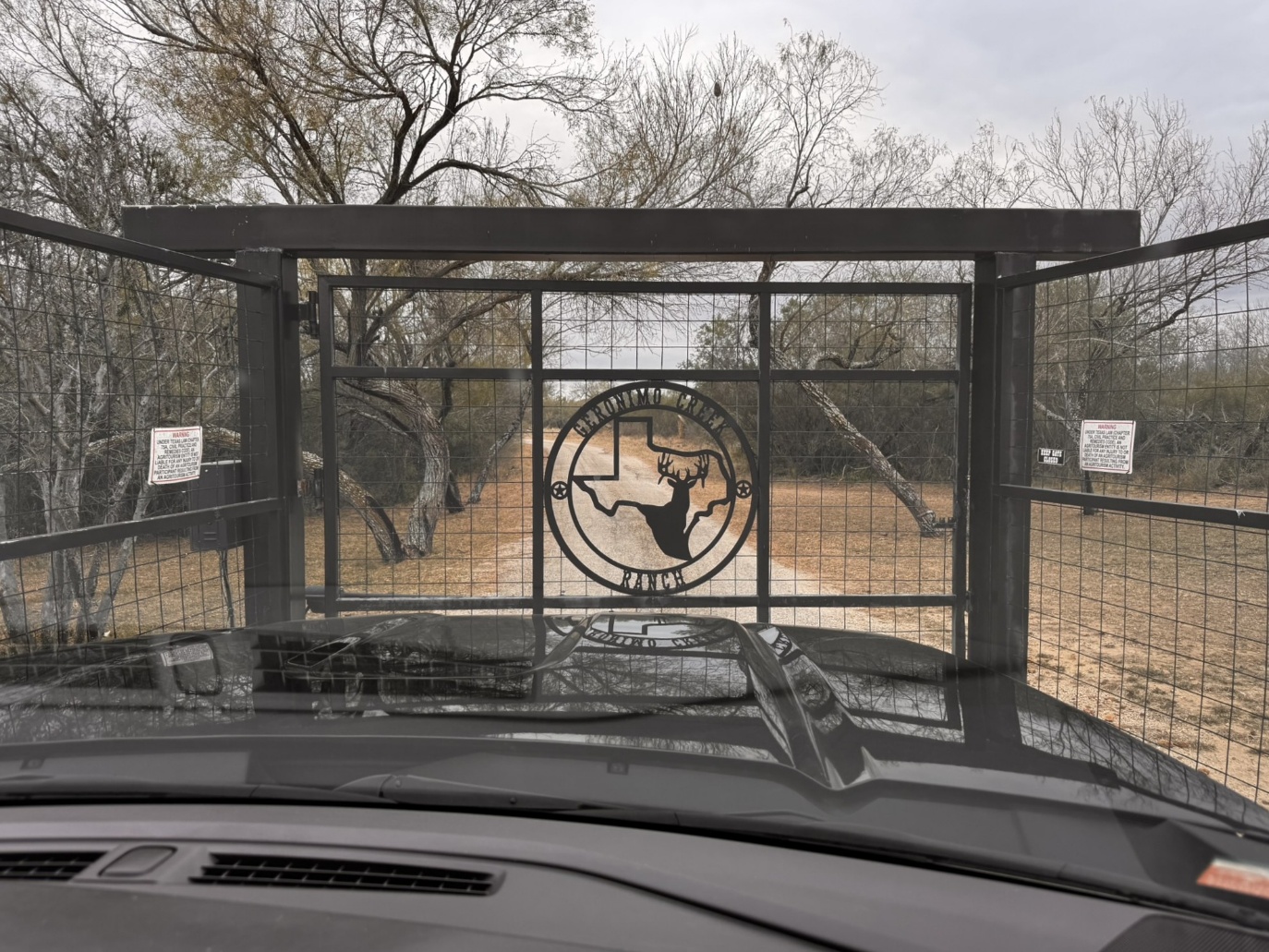
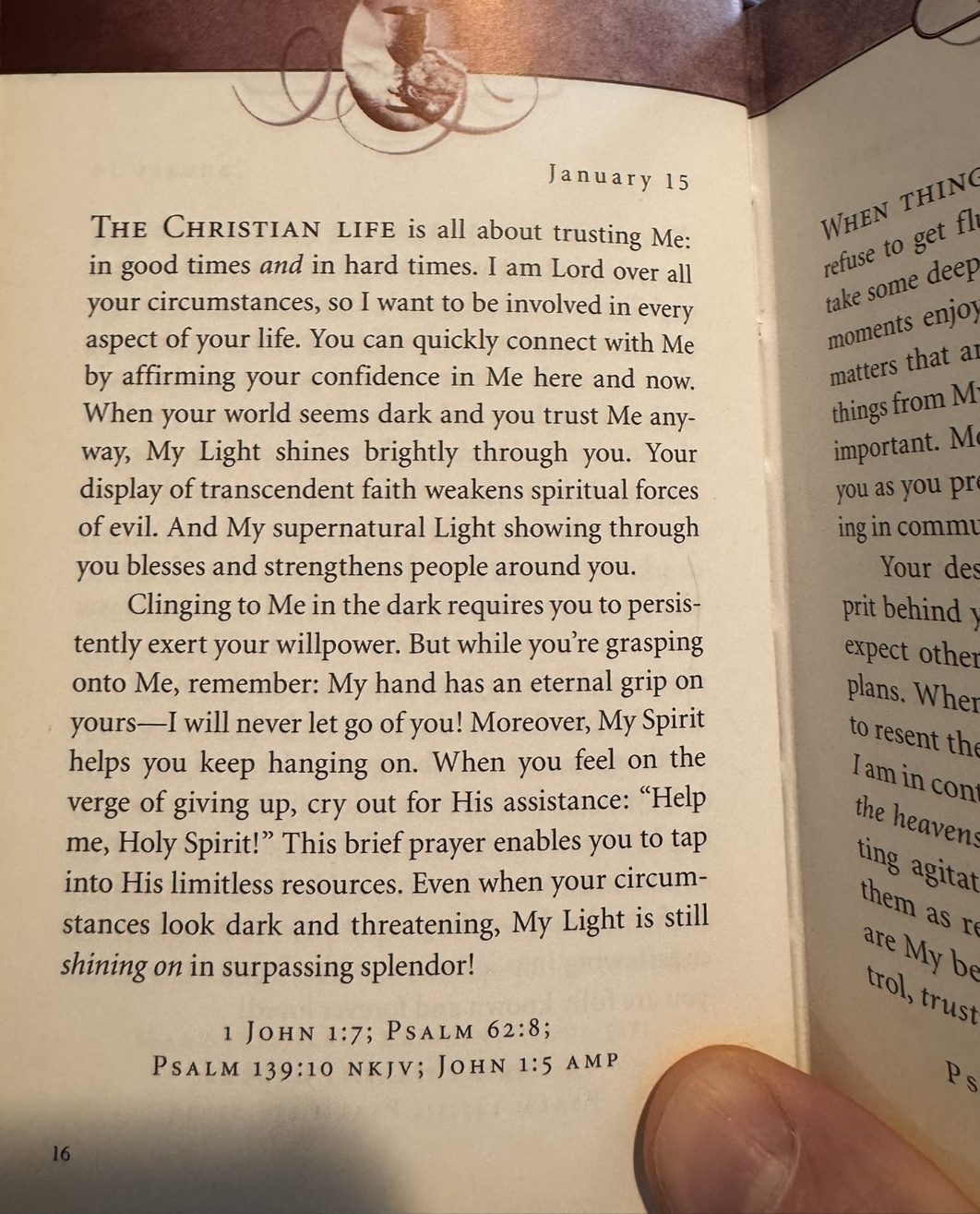
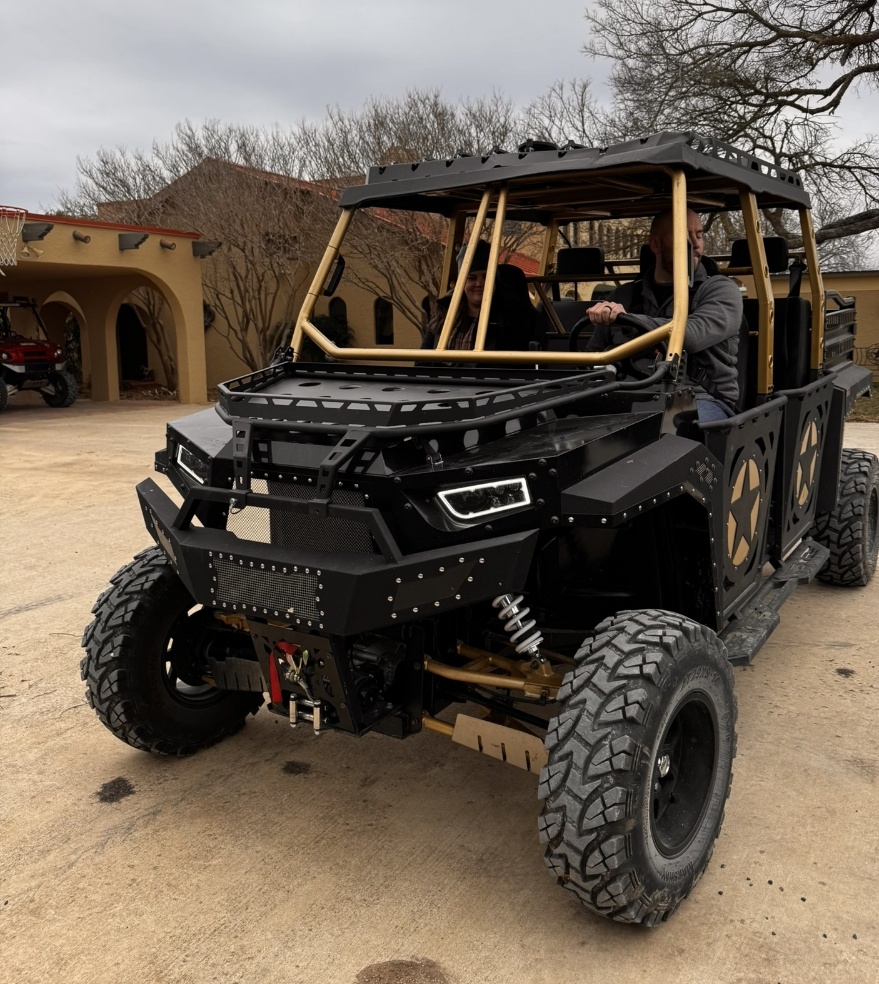
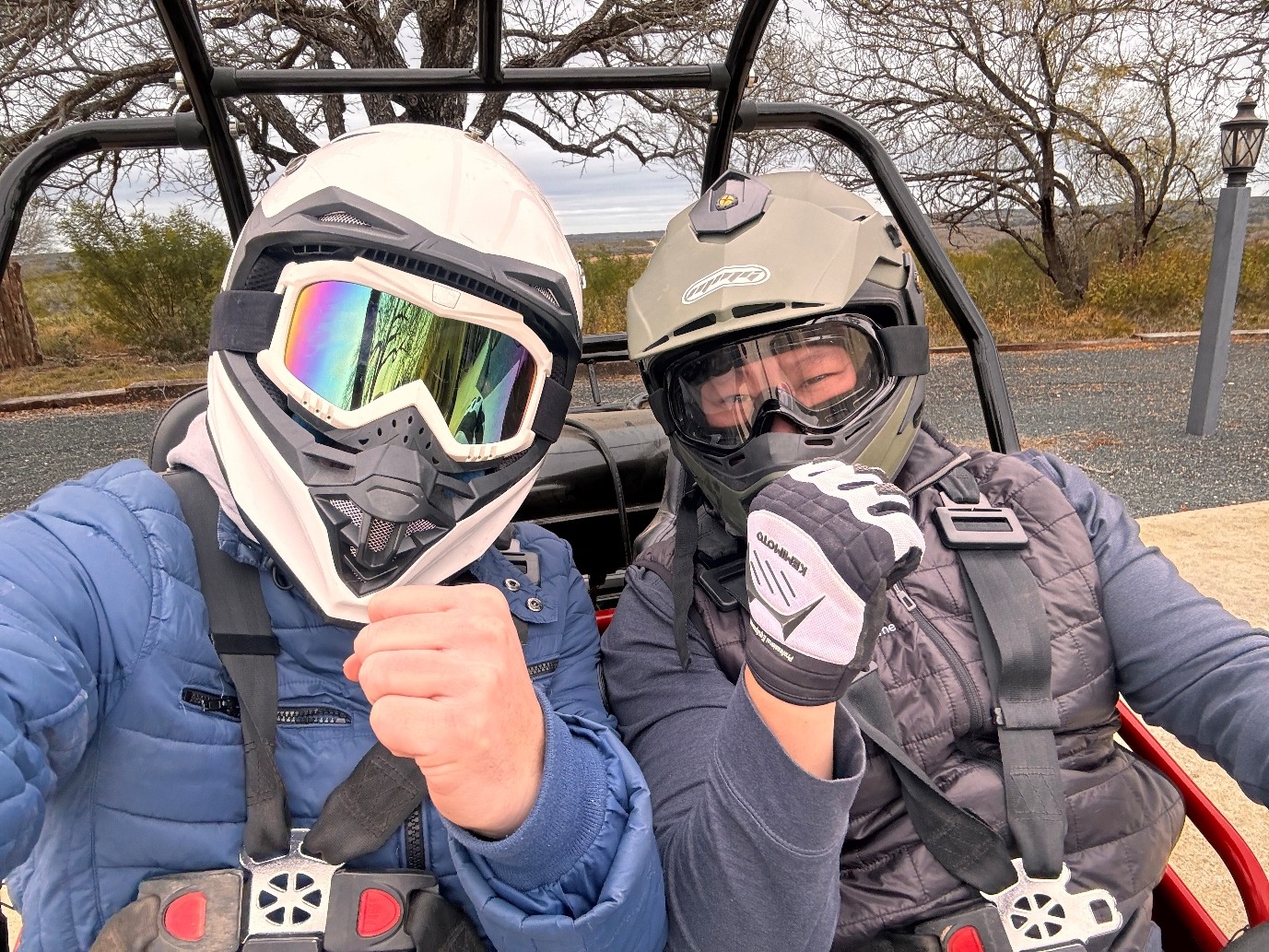
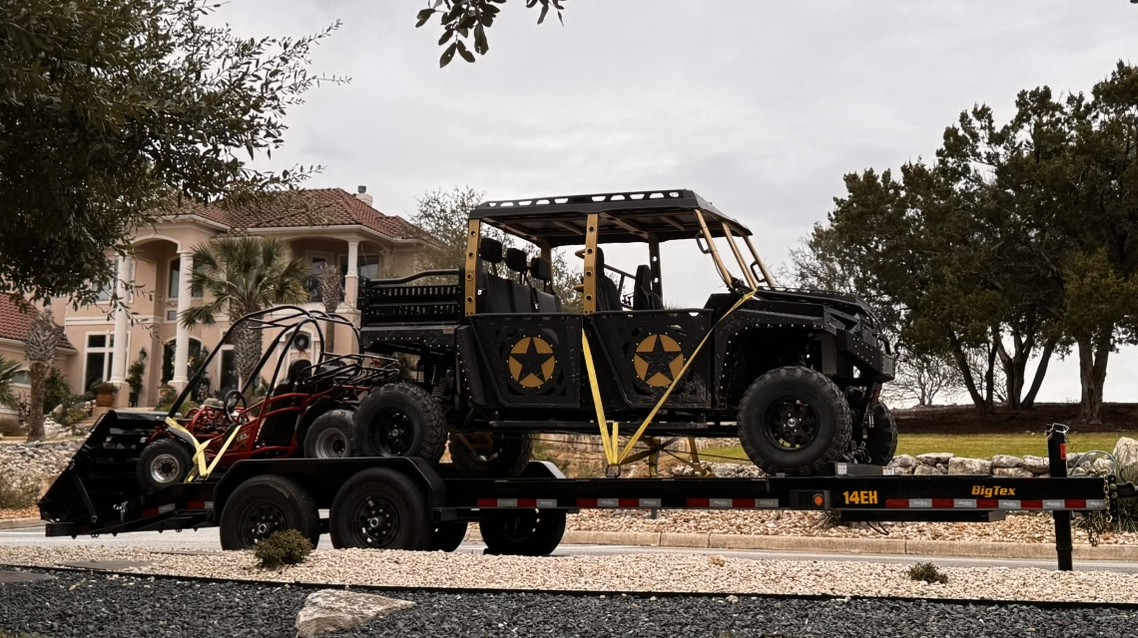
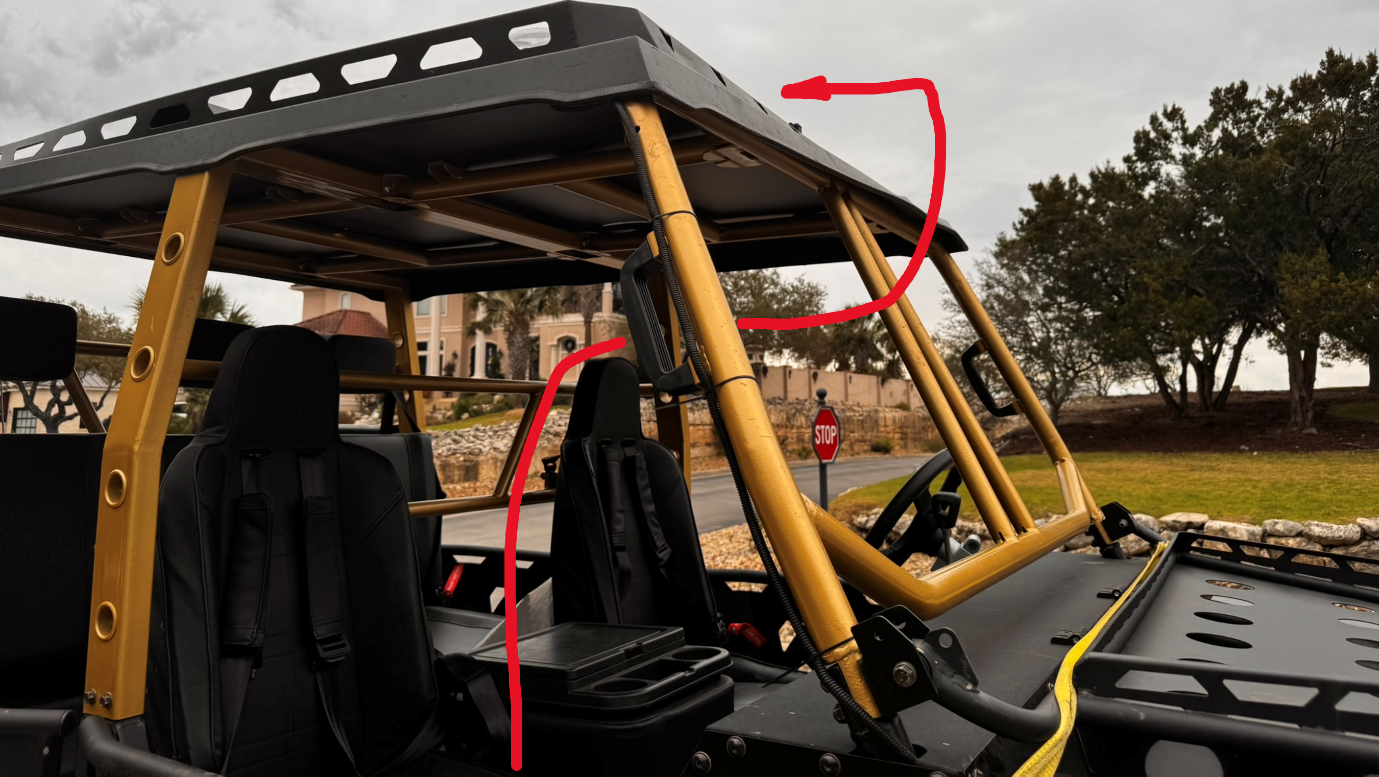

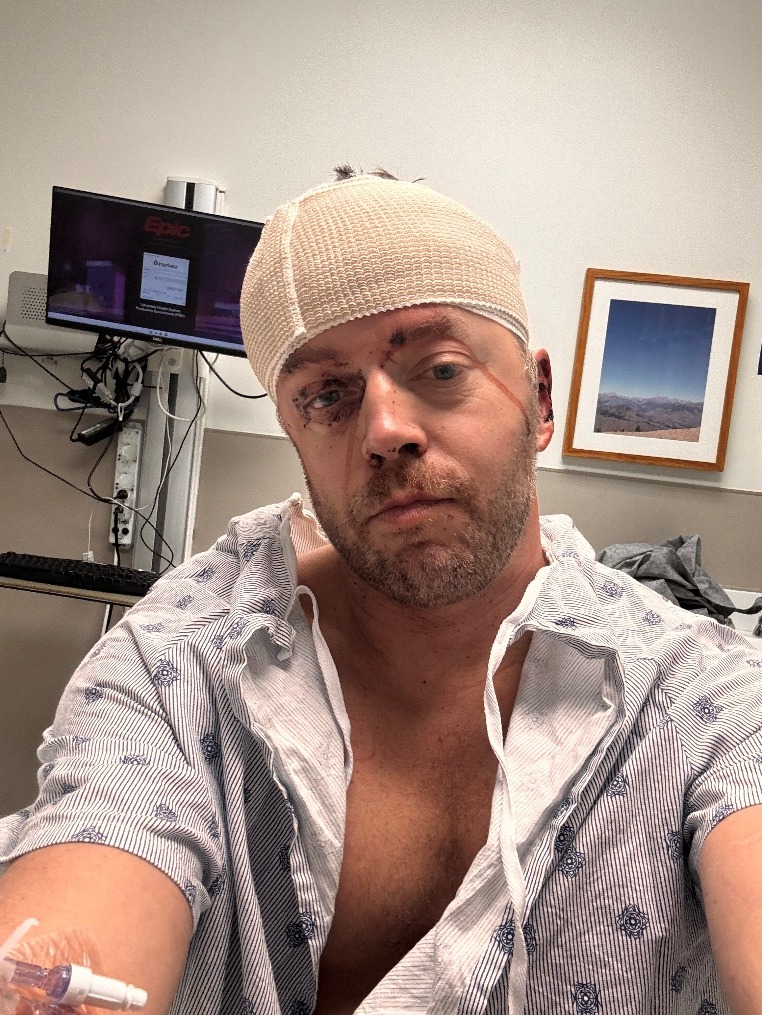
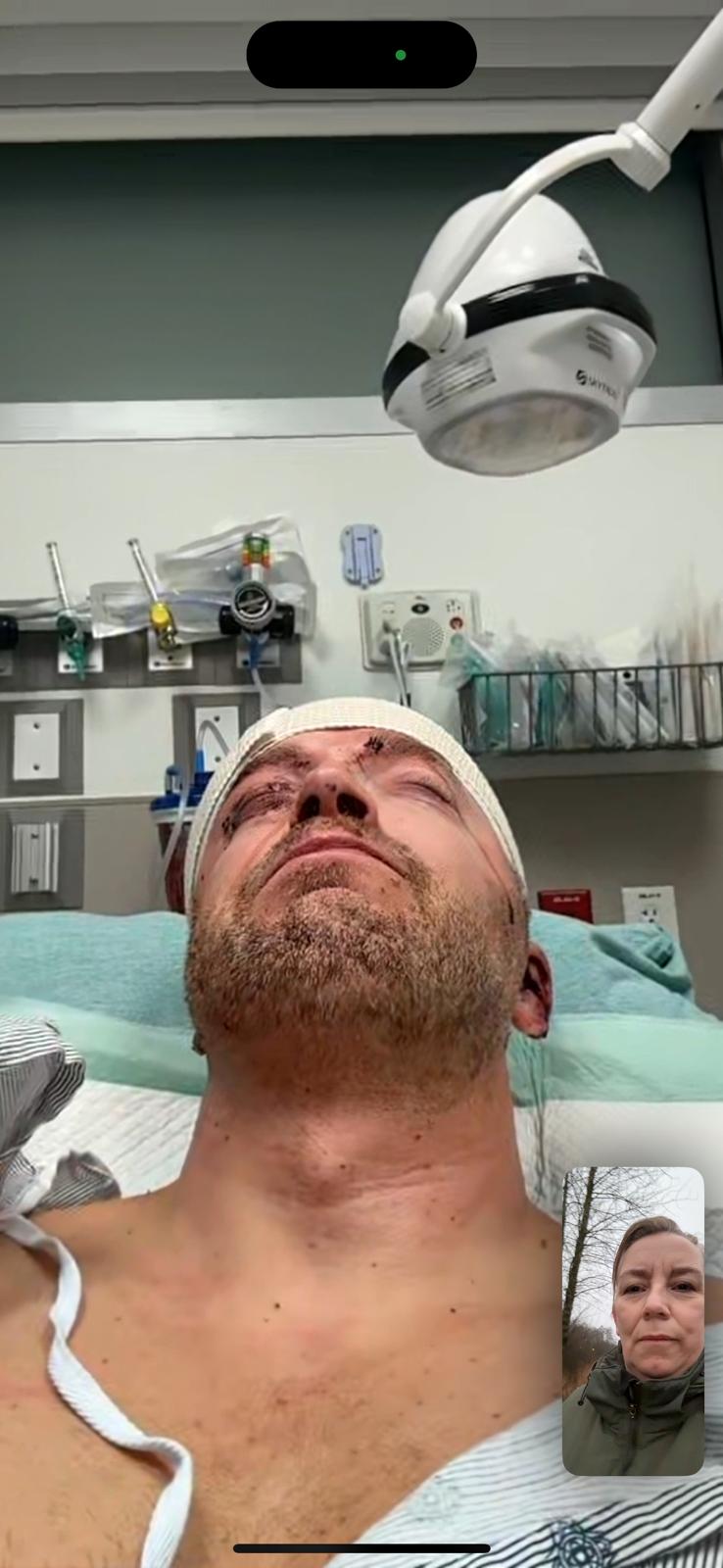 Around
8:00 AM in the Netherlands, I called my wife Jacoline via FaceTime. I
turned my camera off to avoid scaring her, but that plan didn’t work as
intended. Hearing my story alone was enough to leave her completely
shocked. My heart broke as I cried, telling her about the moment I
thought I might die on the spot, not seeing her anymore. It was one of
the hardest things to share.
Around
8:00 AM in the Netherlands, I called my wife Jacoline via FaceTime. I
turned my camera off to avoid scaring her, but that plan didn’t work as
intended. Hearing my story alone was enough to leave her completely
shocked. My heart broke as I cried, telling her about the moment I
thought I might die on the spot, not seeing her anymore. It was one of
the hardest things to share.